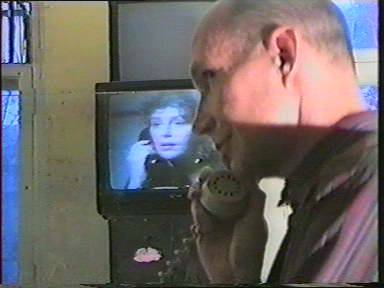
“Kiss on the glass” video installation, 1996
“KISS ON THE GLASS”. THE EXPERIENCE OF THE INTERTEXTUAL CONSTRUCTION
The main peculiarity of the “Kiss on the glass” video installation determining the character of its construction is that the film-text contains all its structural elements. “Kiss on the glass” exists as a model constructed of the different-level elements of the film narrative, existing in the video installation both in the materialized form and as the pure conditional characters (the representations on the monitor screens). The film of “Legacy of Sin. The William Coit Story” (by S. Schachter) is used as the initial material for the “Kiss on the glass” construction.
Narrative matter of the “Kiss on the glass” is organized by means of editing - the main method of the film-narrative organization. Moreover, the method of narrative organization is characterized here as follows: separate stages of the personage‘s individual biography development are implanted in the context conceptually set. “Artificially” constructed narrative (“horizontal” plan) exists here in the limits of the hard expositional structure - three-step scale of ranks, on the first step of which a personage is set, on the second - a personage and a detail, on the third - a detail with a personage‘s sign (“vertical” plan). The “additional” detail (the phone receiver), existing on all of three hierarchical levels, symbolically accentuates the act of communication which is an important aspect of the system‘s functioning. On the other hand, “Kiss on the glass” is a narrative about “William Coit Story...” constructed by means of taking out and temporal placing the basic structural elements of the “Legacy of Sin...” composition into consecutive order. These structural elements are the plot, the culmination and the denouement. Moreover, while the plot (the scene of blackmail) and the culmination (a personage who has made a crime is waiting for the sentence) are realized in the action, -- the denouement is realized by the “talking-detail” - a trace of lipstick on the glass - on the internal side of the “prison partition”, the farewell kiss on the transparent, but insurmountable border of the world which the personage of our narrative probability will never leave.
However while telling about the “Legacy of Sin...”, “Kiss on the Glass” transforms (correct semantically) the original film narrative. It transforms the narrative by the means of the intertextual method, i.e. “Kiss on the Glass” is the outcome of the “Legacy of Sin”, it is reachable by the way of cutting down the original narrative, by reducing it to the tree key situations which also represent the cinematographic situations-cliches.
The other peculiarity of the “Kiss on the Glass” narrative intertextual construction is also essential: the dialog of the “Legacy of Sin” personages is transformed into the monologue (versus: internal dialogue) of the “Kiss on the Glass” personage by the means of editing. One of the personages is “eliminated” from the fragments used as the material: these fragments are the dialogue between two personages in two different situations. The result of this operation is the establishing of the specific perusal duality. On the one hand, preservation of semantic displacements, characteristics of the dialogue, reduces thematic unity of utterance which must be likely an evidence of extraordinarity of the situation (insanity, state of drug intoxication of the personage, etc.). On the other hand, “artificially” constructed monologue establishes a definite connection between the “Kiss on the Glass” personage and the spectator perceiving the video installation. In the situation of the internal dialogue when “the whole speech is being said by the talking I; however, even in these cases the listening I also presents: its presence is necessary and enough for the talking I utterance to get its full meaning” (E. Benveniste), the spectator should be identified with the listening I.
As it has been mentioned before, the “Legacy of Sin...” personage chosen by us is transformed into the “Kiss on the Glass” personage whose individual biography stages (video fragments) are being represented one after the other in the temporal sequence. In the first of them a personage conversating by phone with the invisible interlocutor him with the blackmail. In this fragment the “criminality” of the situation is clearly recognizable, although the events preceding this situation are off screen. In the second fragment that follows the first one we find out personage “beyond” the prison partition and pronouncing incomprehensible monologue referring to a some crime that has happened. Both fragments let us know nothing about the essence of this crime and about what has been caused by. We can only offer the versions apropos of this, turning into our “cinematographic” experience, to “complete” the narrative, bringing it in correspondence with the genre canons. The “talking detail", minimal sign of the woman-personage on the “prison partition” glass in the hall where rendezvouses with the prisoners take place doesn‘t put at the end of our story a point, but three dots.
It is also necessary to mention that the video installation “Kiss on the Glass” is supposed to be of interest not so much from the point of view of the genre poetics (video installation genre as instrument by the means of which the working “inside” the other genre is carrying out, etc.), as from the point of view of relations between the different levels of semantic tension - the level of just the “Kiss on the Glass” narrative, the level of the relations between two plans of components placement (“situations”) of the “Kiss on the Glass” - “temporal” (liner development of subject) and “spatial” (formal hierarchy of the components) and the level of the relations between the “Legacy of Sin...” original film narrative and the transformed “Kiss on the Glass” narrative. Moreover, we don‘t concentrate upon the resemblance, but upon the differences - upon what makes possible to speak about the “Kiss on the Glass” as about the quite different story.
Odessa, September 1996 Miroslav Kulchitsky