BROKEN MUSIC - ARTISTS' RECORDWORKS
Edited by Ursula
Block and Michael Glasmeier
DAAD and gelbe Music: Berlin, 1989.
(book review)
 "...
some day [...] music, previously conveyed by writing, is, in a single
stroke, itself changed into writing; at the price of its immediacy, yet
with the hope, so fixed, it will finally be read as the ´last language
of mankind after building the Tower´", Adorno says in the volume
Broken Music, which gives a comprehensive documentation of and a less
comprehensive study on the avant-garde experimentation with music and
the medium of record. The documentation covers the material displayed
at the Berlin exhibition with the same title in 1988: photos and description
of object records, sound sculptures, installations, performances, record-covers
as original art works and recorded sound made by visual artists, as well
as art publications containing records. Michael Glasmeier´s historical
overview forms the bulk of the study. It traces back the main stages of
the process in which visual artists - eg. John Cage with his "Imaginary
Landscapes", Marcel Duchamp with his "Optical Discs", Nam June Paik with
his Schoenberg performance, Jean Dubuffet through his method of "creative
dilettantism", and Christian Marclay with his grooveless record - made
attempts to break with the traditional habits of hearing, to redefine
the old notion of music that excludes noise, the unmusical and disharmonious
sounds coming from our environment and to use the medium of record as
a material - an objet trouvé - for the visual arts. The emblem
of this process could be the postcard to which René Block refers
in the first essay: Hermine stacks records in a dishwashing machine. In
addition to the brief history, Adorno´s essay on the form of the
record and the experiences of the artists Moholy-Nagy, Jean Dubuffet,
and Milan Knízák are put in print here. The history reads
like this:
"...
some day [...] music, previously conveyed by writing, is, in a single
stroke, itself changed into writing; at the price of its immediacy, yet
with the hope, so fixed, it will finally be read as the ´last language
of mankind after building the Tower´", Adorno says in the volume
Broken Music, which gives a comprehensive documentation of and a less
comprehensive study on the avant-garde experimentation with music and
the medium of record. The documentation covers the material displayed
at the Berlin exhibition with the same title in 1988: photos and description
of object records, sound sculptures, installations, performances, record-covers
as original art works and recorded sound made by visual artists, as well
as art publications containing records. Michael Glasmeier´s historical
overview forms the bulk of the study. It traces back the main stages of
the process in which visual artists - eg. John Cage with his "Imaginary
Landscapes", Marcel Duchamp with his "Optical Discs", Nam June Paik with
his Schoenberg performance, Jean Dubuffet through his method of "creative
dilettantism", and Christian Marclay with his grooveless record - made
attempts to break with the traditional habits of hearing, to redefine
the old notion of music that excludes noise, the unmusical and disharmonious
sounds coming from our environment and to use the medium of record as
a material - an objet trouvé - for the visual arts. The emblem
of this process could be the postcard to which René Block refers
in the first essay: Hermine stacks records in a dishwashing machine. In
addition to the brief history, Adorno´s essay on the form of the
record and the experiences of the artists Moholy-Nagy, Jean Dubuffet,
and Milan Knízák are put in print here. The history reads
like this:
The reproduction of the individual
Edison´s revolutionary invention was marvelled and cursed at the same time by his contemporaries. The phonograph made it possible to reproduce a voice once sounded yet at the expense of stiffening the living voice into death and making the dead voice the only living one. The possibility of the recording of the sound raised the dilemma of individuality versus unlimited mechanical reproduction and thus that of life and death thus, in 1911, Felix Auerbach claimed that the gramophone belonged to the chapter on aberrations in the art-business since it made a distorted copy of the original. As music gradually became prevalent over human voice in recordings, this dilemma shifted to the field of aesthetics. Horrified, artists realized that the music engraved in the record killed music, deprived it of its artistic creativity. The change brought about in the trademark of the gramophone records in 1909 properly symbolizes this transition. The angel inscribing grooves on the record with a kind of a quill was substituted for the dog Nipper - the passive consumer - listening patiently to the mechanical voice of his master. This shift was inevitable: in a writing oriented culture, sound, if transcribed, must become a document, an acoustic photograph, lastly, an object.
The reproduction of that which has never sounded out
The Futurists, the Dadaists as well as the Bauhaus were concerned with the problem to turn reproduction into creative production. In 1923, László Moholy-Nagy suggested that compositions should be created directly on the record, which might well astonish modern CD consumers. Having experienced the course of the spirals etched in the record with the help of a needle, he says, one could establish his own "Ritzschrift" (etching)-ABC. Applying this specific but unique language one could engrave the graphic diagrams onto the surface of a large record by his own hand. The engraved record then could be reduced by the means of photography to the size of the conventional records. Transforming graphic diagrams into music was, however, not welcomed by musicians but it cast light upon the written character of sound. Music can be depicted without ever having been sounded out.
The unique and the irreproducable
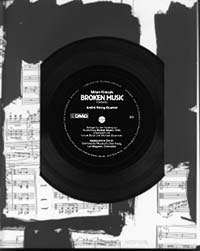
By breaking, piercing, painting, cutting and sticking records, Milan Knízák made a series of collages called "Broken Music" in the sixties. His "prepared" records cannot be played by the record played, the pick-up won´t follow the distorted spiral of the grooves: the music inscribed will not sound out any more. These records ceased to be records in the true sense of the word. They are mere record objects - distorted yet recognizable -, unique artifacts which cannot be reproduced. Sounds engraved in the destroyed records cannot be transcribed in any system of signs. In fact, the record itself has become a sign - yet, within what system should this sign be interpreted?
(Ágnes Ivacs)