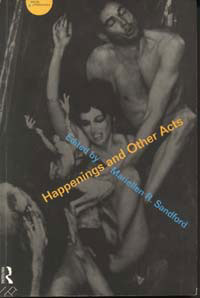
Happenings and Other Acts
edited by Mariellen R. Sandford. London and New York: Routledge, 1995
(book review)
 What
is a Happening?
What
is a Happening?
"There is a prevalent mythology about Happenings. It has been said, for example, that they are theatrical performances in which there is no script and "things just happen". It has been said that there is little or no planning, control, or purpose. But these myths are entirely false" (Michael Kirby). Then what is the truth about Happenings?
The name "Happening" originated from Allan Kaprow´s earliest public work called 18 Happenings in 6 Parts (1959) and became a collective term for a variety of performances ranging from play, to theatre, dance, and music, to rituals which were at that time referred to by different names. In order to arrive at a definition that is inclusive enough to take in all of these works Happenings may be considered a form of theatre spectacle, a wider aesthetic category, which stem from the rejection of the traditions and from the conceit that everyone in the audience sees the same "picture". Misunderstandings arise from the fact that the structure of the Happenings is compartmentalized: each unit is a whole in itself, and these units cannot be organized into an imaginary time/space universe characteristic to traditional theatre since there is no causal plot. Thus a Happening is non-diegetic and non-matrixed concerning time and place relations. Action is undeterminate and functional. The performers as characters are allegorical, and persons are treated as objects. There is no relevant framework of reason to which impressions may be referred. Yet Happenings do have a certain dramaturgic homogeneity and thematical unity.
Antecedents
In his essay "Assemblages, Environments and Happenings" Kaprow describes the evolution of Happening as a progression from action painting to Assemblages, Assemblages extending into Environments, and Environments incorporating environmental sounds and effects and especially people, by extension, became Happenings. As opposed to Kaprow, in his introductory essay Michael Kirby states that Happenings have nothing to do with plastic arts, they are in fact a new form of theatre. Are they? If we redefine theatre as Cage did saying that theatre is a performance which engages simultaneously the two public senses of eye and ear, then they are. The roots go back to Dada and Bauhaus performances, to the presentational acting characteristic to the plays of Pirandello, and Williams, to Brecht´s Verfremdung-theory, to dance, to Artaud´s Theatre of Cruelty, and to the Surrealists.
Typology
In his brilliant typological analysis Darko Suvin groups Happenings in four different categories. Events are single nonverbal activities. Aleatoric scenes are longer aleatoric activities where text is treated mainly as sound. Happenings proper range from nonverbal symbolic activities to clear compositions with well-rehearsed actors and a composed text, like modern allegorizing plays. Finally Action Theatre which might be nearer to drama than to Happenings.
The Aim of Happenings and the Aberrant Subject/Object Relationship
"I am concerned about the state of our society", Kaprow says in an interview included in this volume but he rejects illustrating social or cultural concepts. Art should be discovery, an experiment with time and space, he states and proposes that as opposed to theatre´s limited space - that is rather a container to which the event is fitted - a new notion of space should be introduced according to which events make the space, or create isolated nodes of spatial meaning. Time, which follows closely on space considerations, should be variable and discontinuous. Fluids, a happening by Kaprow is a good example of his work:
A single event done in many places over a three-day period. It consists in building huge, blank, rectangular ice structures thirty feet long, ten feet wide, and eight feet high. People set the structures up using rock salt as a binder - which hastens melting and fuses the blocks together. The structures are built about 20 places throughout Los Angeles. If one crosses the city he might suddenly be confronted by these mute and meaningless blank structures which have been left to melt. The structures indicate no significance, their very blankness and their rapid deterioration proclaims the opposite of significance.
In Kaprow´s, and other artists´ Happenings space and time cease to be conventions: they become problematic materials. Space becomes the sum of all objects structured through object-relations which include real objects, as well as people. Happenings thus assign the audience the same ontological status as the performers: both can provide performance-events, both are treated as objects.
European Happenings must be distinguished from their U.S. counterparts because of their overtly political nature. For Jean-Jacques Lebel art, above all, must be a sociopolitical critique of the consumer society. Art and crisis are one and the same, and artists disgusted with the "civilization of happiness" must reform social and cultural life through breaking taboos concerning sex and death, violating prohibitions. Lebel argues that art can create an impersonal freedom of thought and thus it establishes an interpersonal communication between the artist and its audience. Happening is no longer the art of voyerism that lets art be at the mercy of the shortsighted but the art of participation which introduces the looker directly into the event. It eliminates the old ontological dilemma of "aberrant subject-object relationship", the cause of alienation, by equating thought and action, representation and creation. But while giving up "painting battles for waging them" directly in the society, Lebel failed to realize that Happenings have turned the subject/object relationship into an object/object relationship.
The Eclipse of Happenings
Happenings were designated to reorient people through the direct perception of an aggressive kind of experience, by brainwashing, and shocking them. Artists theatricalized their audience which thus became its own spectacle. Subjectivity, the lack of interest in the audience, the magico-religious stance, the ignoring of language and blindness to history, Suvin concludes, have prevented Happenings from becoming a major spectacle form.
A unique and important collection of reflective and analytical essays, photos, interviews, happening descriptions and texts, Happenings and Other Acts is part of the Worlds of Performances Series, which is designed to explore the panoply of genres categorized as performances, bringing back into print important essays, interviews, artists´ notes, and photographs. Each Worlds of Performance book is a complete antology, arranged around a specific theme or topic.
Esposizione, a small opera by Ann Halprin, originally traditional dancer, explored the architectonic concept of space and was performed on a large stage. To make the relatively large stage compared to the audience sufficient for their six-member company performance they suspended a cargo net across the proscenium in the air, to allow the dancers to move vertically. The dance evolved out of a spacial idea. They said that the theatre was their environment and they were going to move through the theatre. They took a single task: burdening themselves with enormous amounts of luggage. Each person had to carry all kind of everyday objects: automobile tires, gunnysacks filled, bundles of rags, newspapers rolled up, etc, and to allow his movements to be conditioned to speeds that had been set up for him. They started all over the place, so that it was like an invasion. The music started at a different time, dancers started at different times, so that the audience had no idea when anything started. The whole dance was a series of false beginnings. As soon as something got started, something else would be introduced. The dancers´ task was to carry things and to penetrate the entire auditorium. When they reached the high point they let the objects roll down, the whole space exploded.
(Ágnes Ivacs)