RETHINKING TECHNOLOGIES
Edited by Verena Andermatt Conley, on behalf of the Miami Theory Collective, Minneapolis-London: University of Minnesota Press, 1993
(book review)
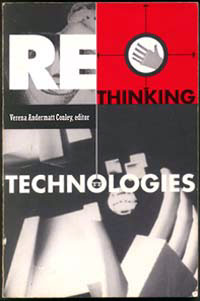 Rethinking
Technologies investigates how technology affects various fields of life
in an epoch that is characterized by the irrelevance of the question of
meaning. The "modern project" resting on the pillars of liberal democracy,
social equality and on the philosophical idea of evolution with the autonomous
and self-possessed subject in its centre that ventures to understand the
world by the methods of science and control it by the means of technology
in order to transcend the body, matter, place, and the tedium of work
has led to a "void", or "vacuum": a different cultural, intellectual,
and social landscape that can no longer be interpreted within our existing
frames of reference. In this new reality ecological catastrophes, social
inequities, wars, and the depression of values in the social and political
fields show that the world cannot be viewed merely as a scientific object.
Technology decenters humans´ position threatening the singularity
of the subject with annihilation. This calls for redefining the position
of technology in the humanities and concluding a new alliance of the humanities
and the sciences. The authors of this collection of essays attempt to
address technology from a positive critical stance and rethink it in the
light of the contemporary discourse on philosophy, psychoanalysis, and
the arts. The essays deal with the effects of televised representation
and technology on community and activity, Hollywood´s fabrications
of history as it remaps the collective unconscious and produces strategies
that define the imagination, and ways in which the technology of visibility
transforms fantasy into everyday reality; and are grouped around the issues
of the effect of the technologies in general, the relationship of technology
and the environment, the arts, and cyberspace. The essays are not arranged
in a linear sequence but the interplay among those included in the same
chapter complicates the chosen topic. Contributors are leading theoreticians
of Continental and Anglo-American thought: Paul Virilio, Félix
Guattari, Jean-Luc Nancy, Avital Ronell, Verena Andermatt Conley, Teresa
Brennan, Ingrid Scheibler, Alberto Moreiras, Françoise Gaillard,
Scott Durham, N. Katherine Hayles, and Patrick Clancy.
Rethinking
Technologies investigates how technology affects various fields of life
in an epoch that is characterized by the irrelevance of the question of
meaning. The "modern project" resting on the pillars of liberal democracy,
social equality and on the philosophical idea of evolution with the autonomous
and self-possessed subject in its centre that ventures to understand the
world by the methods of science and control it by the means of technology
in order to transcend the body, matter, place, and the tedium of work
has led to a "void", or "vacuum": a different cultural, intellectual,
and social landscape that can no longer be interpreted within our existing
frames of reference. In this new reality ecological catastrophes, social
inequities, wars, and the depression of values in the social and political
fields show that the world cannot be viewed merely as a scientific object.
Technology decenters humans´ position threatening the singularity
of the subject with annihilation. This calls for redefining the position
of technology in the humanities and concluding a new alliance of the humanities
and the sciences. The authors of this collection of essays attempt to
address technology from a positive critical stance and rethink it in the
light of the contemporary discourse on philosophy, psychoanalysis, and
the arts. The essays deal with the effects of televised representation
and technology on community and activity, Hollywood´s fabrications
of history as it remaps the collective unconscious and produces strategies
that define the imagination, and ways in which the technology of visibility
transforms fantasy into everyday reality; and are grouped around the issues
of the effect of the technologies in general, the relationship of technology
and the environment, the arts, and cyberspace. The essays are not arranged
in a linear sequence but the interplay among those included in the same
chapter complicates the chosen topic. Contributors are leading theoreticians
of Continental and Anglo-American thought: Paul Virilio, Félix
Guattari, Jean-Luc Nancy, Avital Ronell, Verena Andermatt Conley, Teresa
Brennan, Ingrid Scheibler, Alberto Moreiras, Françoise Gaillard,
Scott Durham, N. Katherine Hayles, and Patrick Clancy.
Art offers a fruitful ground for Françoise Gaillard to observe the evolution of the modernist enterprise. In her essay "Technical Performance: Postmodernism, Angst, or Agony of Modernism?" she is looking for an answer to the question whether "the wellsprings of art has really run dry" or it is the obsoleteness of our criteria for judging art that causes our incomprehension. The ghost of the negative aesthetics of modernity which describes the artist as an autonomous individual opposed to the society and defines his role as social criticism prevents us from justifying contemporary art which seems to be reduced either to an ironical reproduction of the mass media images or to a latter-day romanticism. A tendency of banalization, "kitschization", and loss of meaning characterizes postmodernity, a term with which we disguise our lack of understanding of the phenomena that while seeking forms only to produce aesthetic effects detaches the symbolical from its context and reduces art to pure signalism without an unifying project. Current theories blame the avant-garde for dissolving the aesthetic norms by putting the banal on a pedestal thus exhausting the creative powers of negativity. Gaillard rejects exhaustion theory arguing that modern art should be viewed in the light and as an inevitable consequence of the Renaissance ideal of man and of 17th century´s rationalism and, setting the problem in a broader social context, she claims that it is liberalism which having eliminated mystery, the absolute, and metaphysics had cut off the individual from transcendence dooming it to the persuit of the personal. Art in its present condition reflects this phenomenon. Thus the death of art is the sign of the death of all critical functions in liberal society. In the mass media din, it is left for the art to portray the subject´s quest for the lost transcendence with irony: like American writer Ballard does in his novel Crash, which is about a man who dreams of reuniting with transcendence in a fatal crash with media star Elizabeth Taylor, Scott Durham argues completing the analysis of art with hyperreality and televised representation.
(Ágnes Ivacs)