SOCIAL - ART. MAIL - ARTPROJECT,
Sonde Aarhus Kunstmuseum, Aarhus, Denmark, November, 1984
Organized by Mogens Otto Nielsen / Atmosphere Controlled, Hjallerup, Denmark
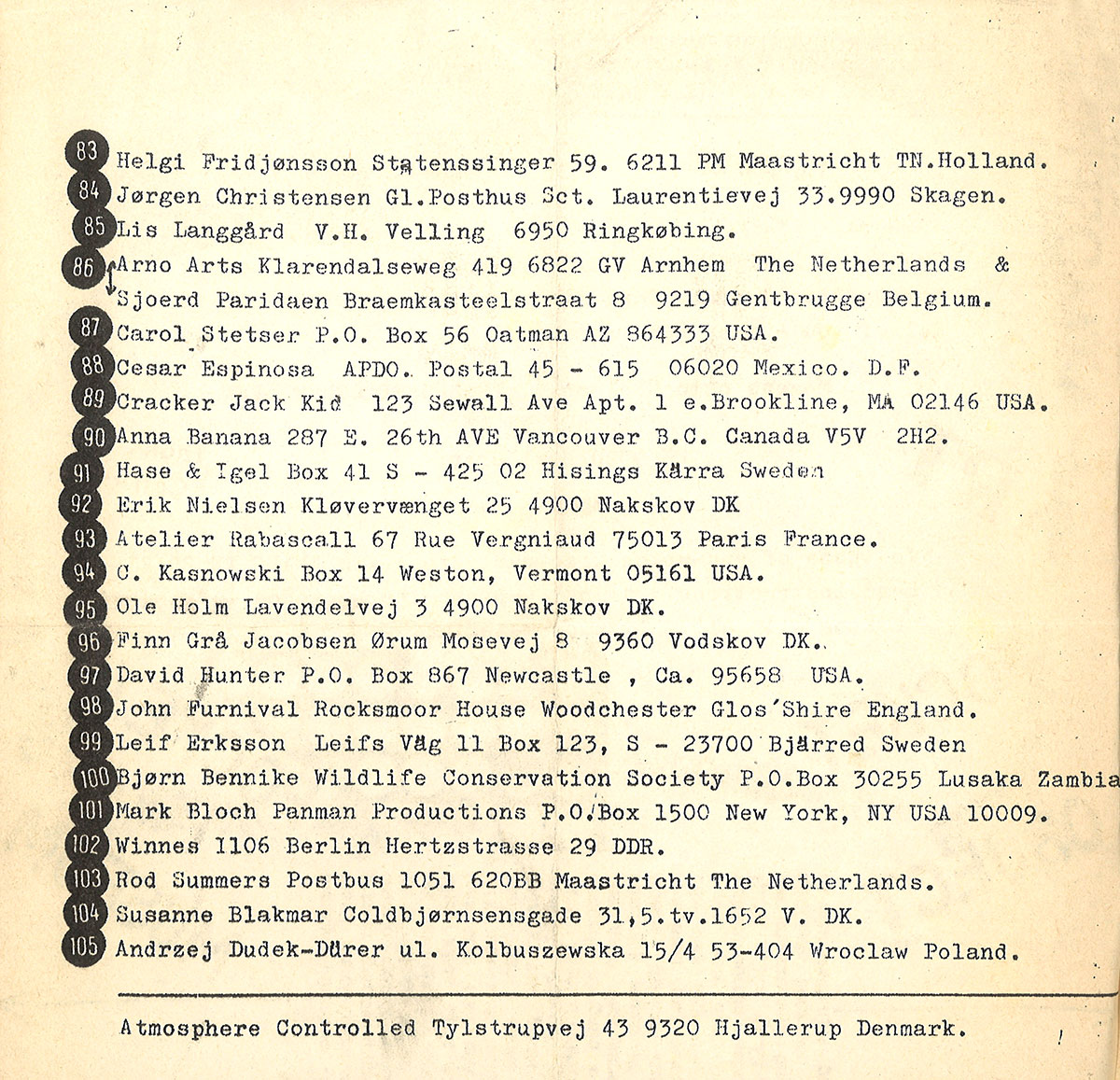
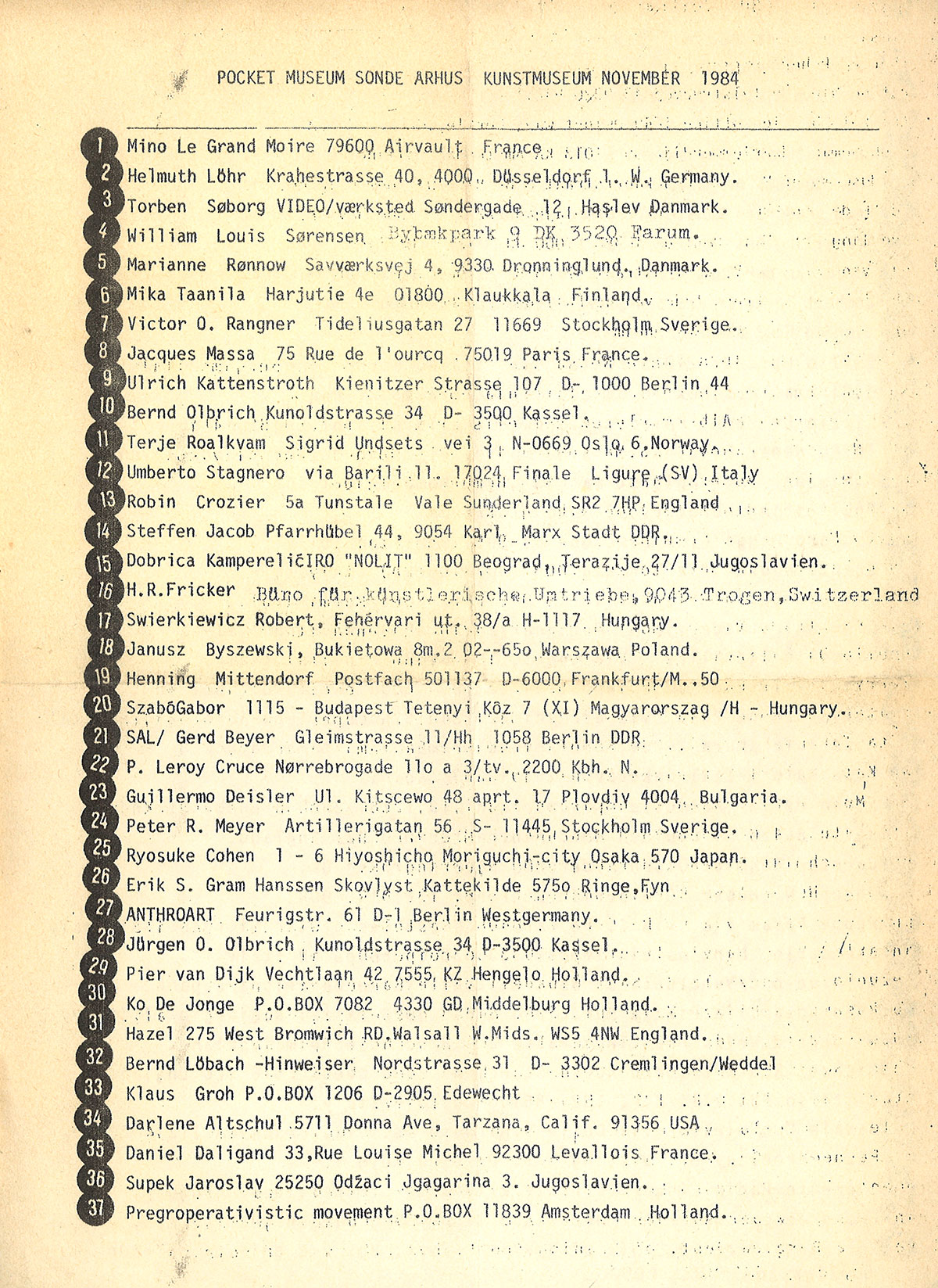
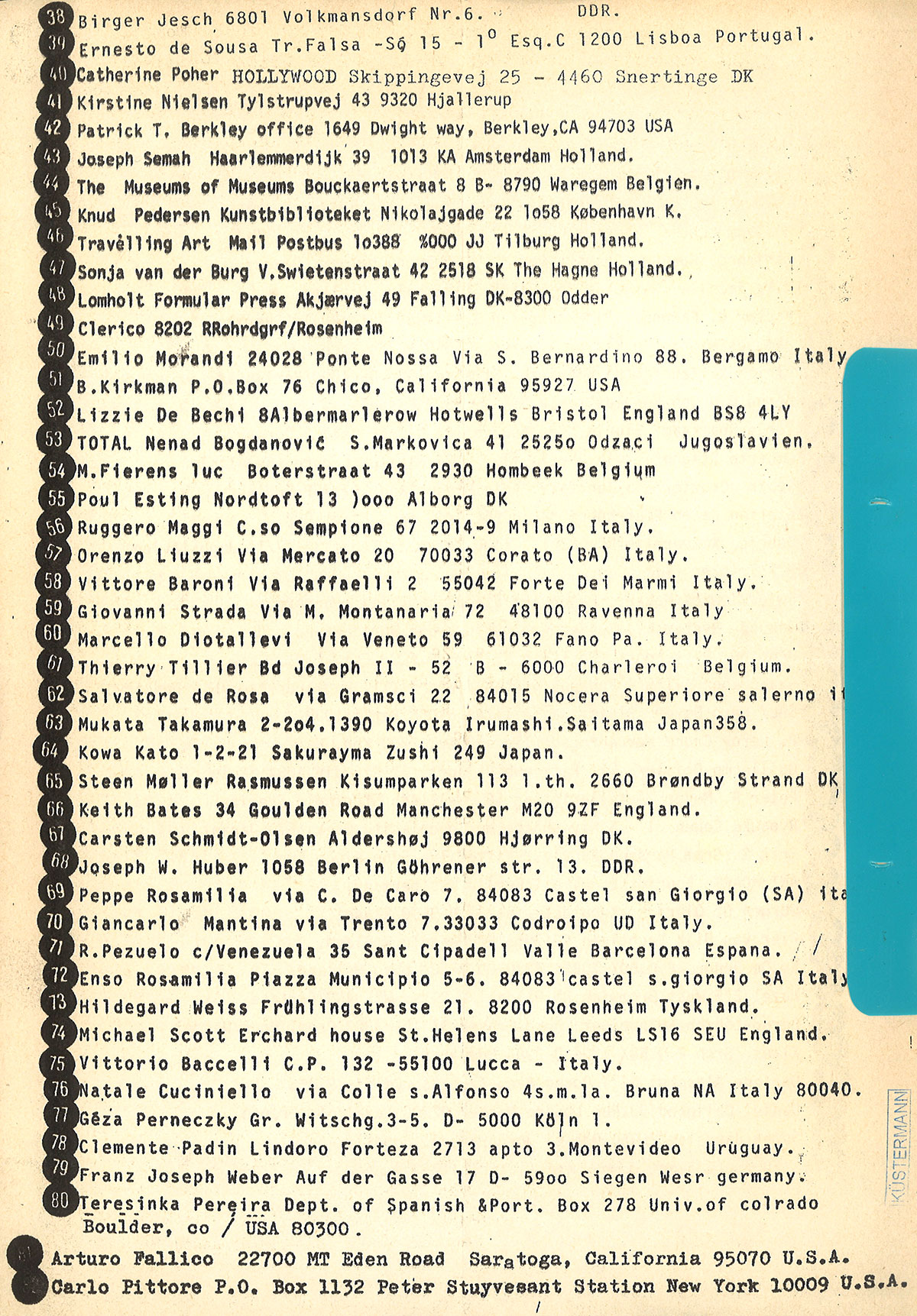
Pocket Museum was a mail art project and exhibition organized by the Danish artist Mogens Otto Nielsen, operating under the collective identity Atmosphere Controlled, based at Tylstrupvej 43, DK-9320 Hjallerup, Denmark. The project culminated in a group exhibition held at the Sonde Aarhus Kunstmuseum in November 1984, bringing together contributions from 105 participants spanning more than two dozen countries across Europe, North America, South America, Asia, and Africa — a geographic scope that underscores the genuinely global reach of the international mail art network in the mid-1980s.
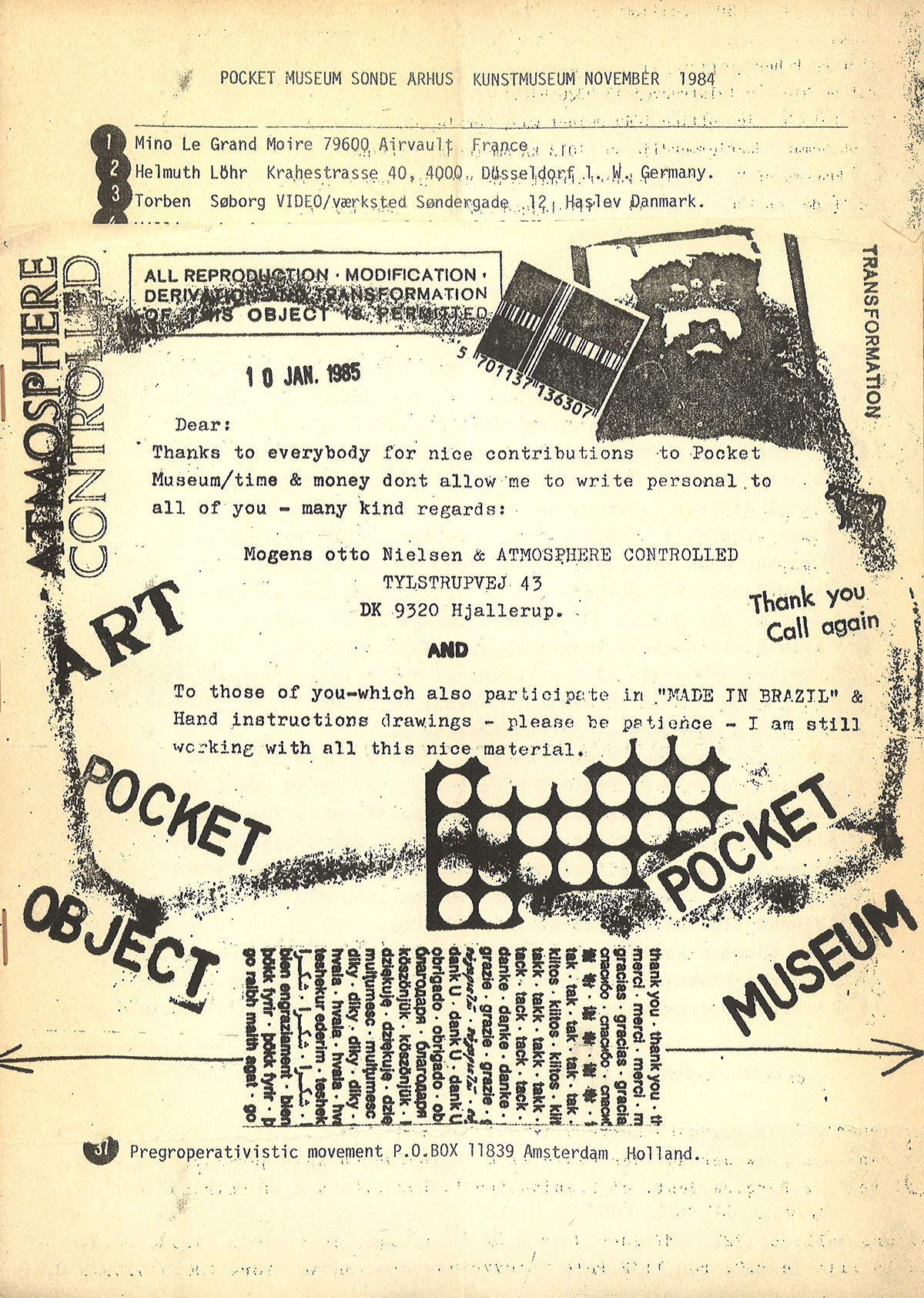
The project's conceptual framework was rooted in the mail art tradition of the portable, reproducible, and transformable object. The circular accompanying the List of Participants bears an explicit philosophical declaration — "ALL REPRODUCTION · MODIFICATION · DERIVATION AND TRANSFORMATION OF THIS OBJECT IS PERMITTED" — aligning Pocket Museum firmly with the anti-copyright ethos that characterized much of the international postal art network during the Cold War era. The very title, Pocket Museum, evokes the democratization of the museum space: art collected and distributed through the postal system, bypassing institutional gatekeepers, and arriving as a tactile, intimate object in the hands of each recipient.
The post-exhibition circular, dated 10 January 1985, was sent by Nielsen to all contributors as a collective thank-you — a standard and humanizing practice of the mail art network, where reciprocity and acknowledgment were considered essential to maintaining the postal community. In this letter, Nielsen also references two parallel ongoing projects for which he was simultaneously processing contributions: "Made in Brazil" and "Hand Instructions Drawings", indicating that Pocket Museum was one of several concurrent initiatives running through the Atmosphere Controlled node of the network.
The List of Participants is a rich cartographic document in itself. Among the 105 networkers documented are prominent figures of the international mail art community, including Guillermo Deisler (Bulgaria/Chile), Ryosuke Cohen (Japan), Anna Banana (Canada), Clemente Padin (Uruguay), Rod Summers / VEC (Netherlands), Klaus Groh (Germany), Vittore Baroni (Italy), Géza Perneczky (Germany/Hungary), Andrzej Dudek-Dürer (Poland), Ruggero Maggi (Italy), John Furnival (England), Mark Bloch / Panman Productions (USA), Carlo Pittore (USA), and Lomholt Formular Press (Denmark) — the latter representing the archive of fellow Danish networker Niels Lomholt, whose collection is today preserved in the Lomholt Mail Art Archive. The presence of artists from East Germany (DDR), Hungary, Yugoslavia, Poland, and Bulgaria is particularly noteworthy, reflecting the role of mail art as a channel of cultural exchange across the Iron Curtain at a time when such exchanges were politically fraught.
Mogens Otto Nielsen was a central node of the Scandinavian and Northern European mail art network throughout the 1980s, running multiple projects and maintaining an extensive correspondence. His Atmosphere Controlled imprint served as the administrative and creative hub for these activities.