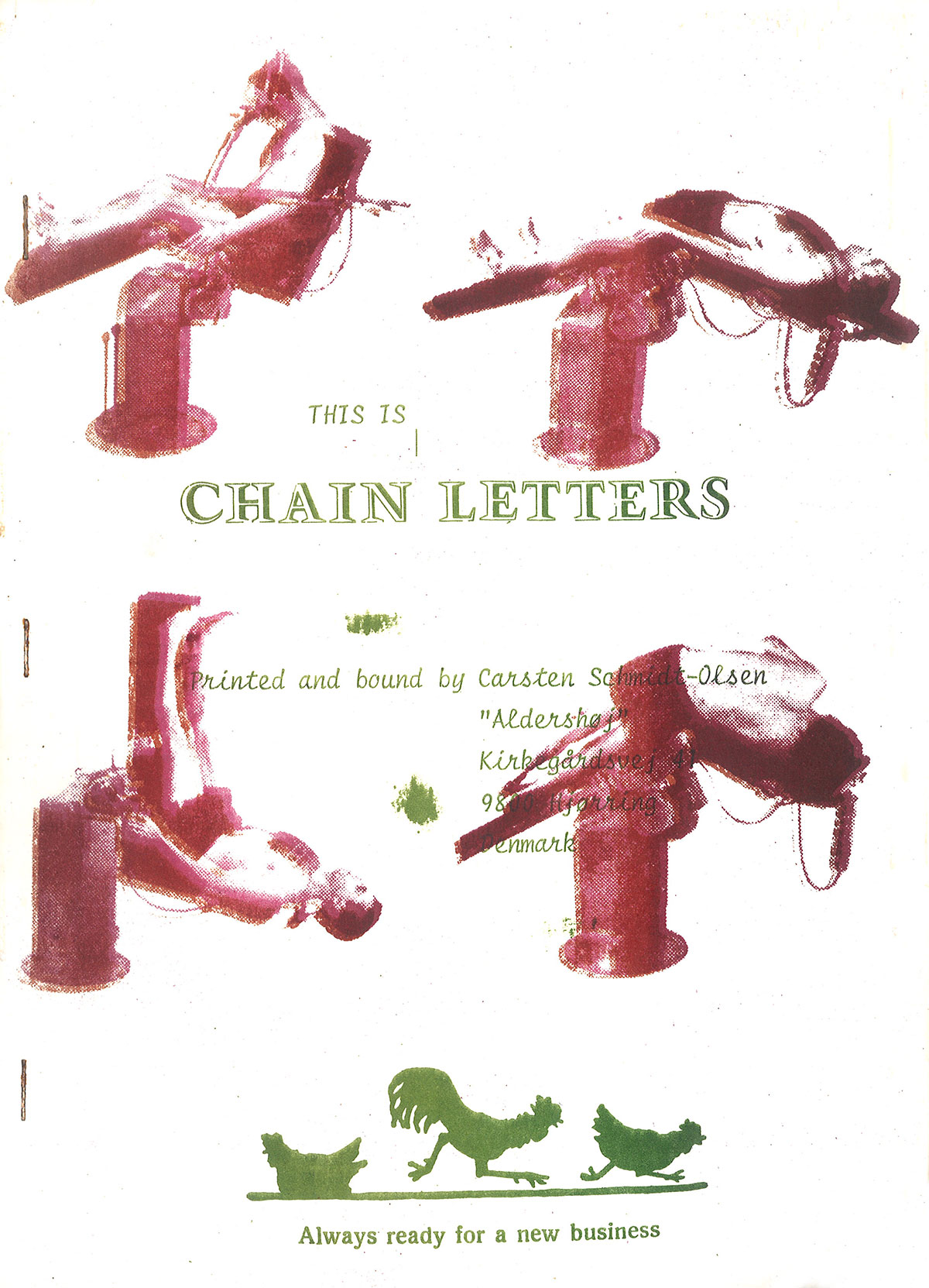
This Is Chain Letters,
Aldershøj, Kirkegårdsvejen, 9800 Hjørring, Denmark, [1986].
Unpaginated. Self-published assembling publication. Printed and bound by Carsten Schmidt-Olsen.
This Is Chain Letters represents a rare and remarkable specimen within the international Mail Art network: a self-propagating, participatory document that accumulated its own history as it traveled through the postal system. According to the instruction text printed within the publication, the chain "started in 1973" — placing its origins in the very year that David Zack published his foundational essay "An Authentik and Historikal Discourse on the Phenomenon of Mail Art" in Art in America (January–February 1973), effectively encoding the chain within the founding mythology of the movement itself.
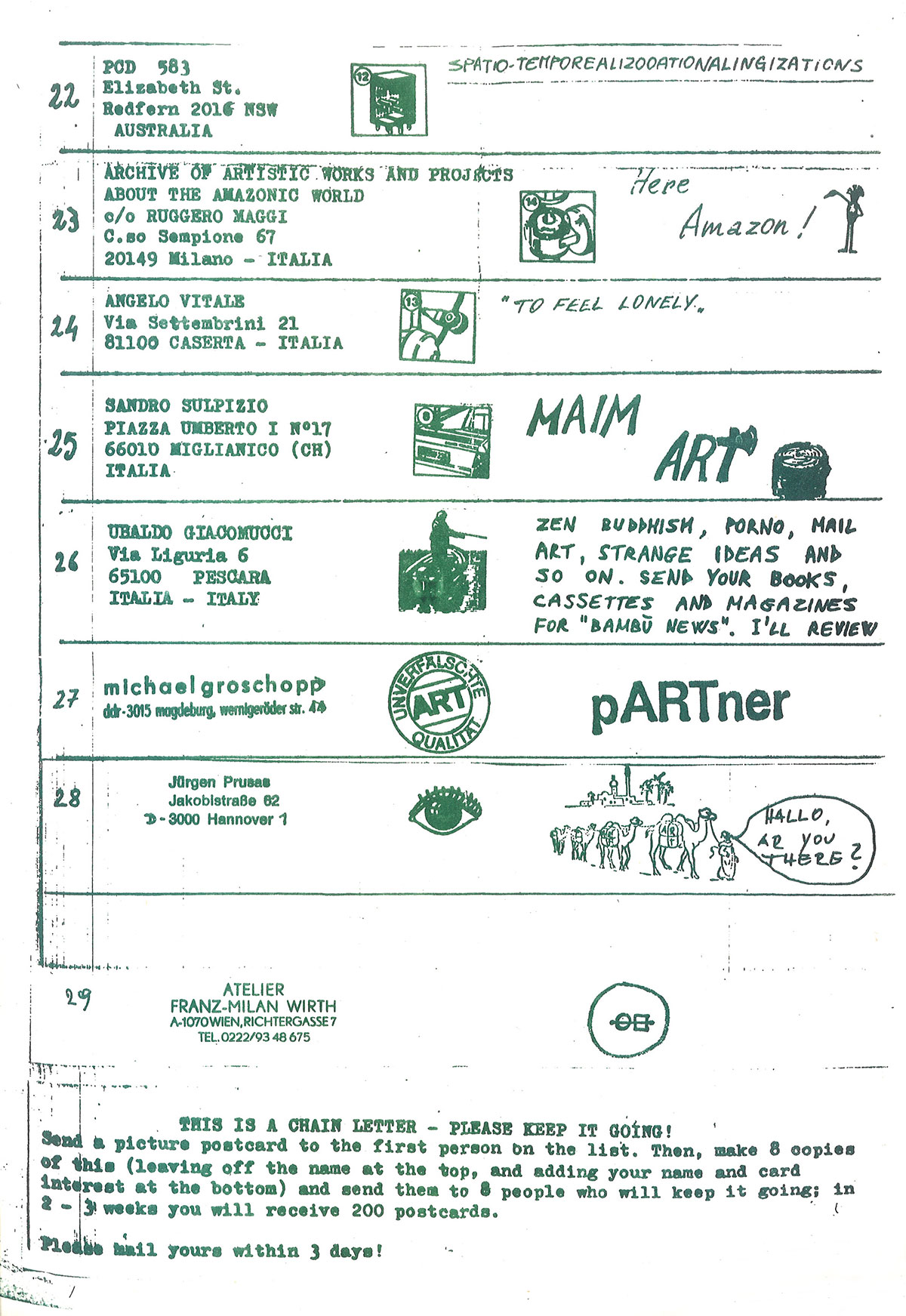
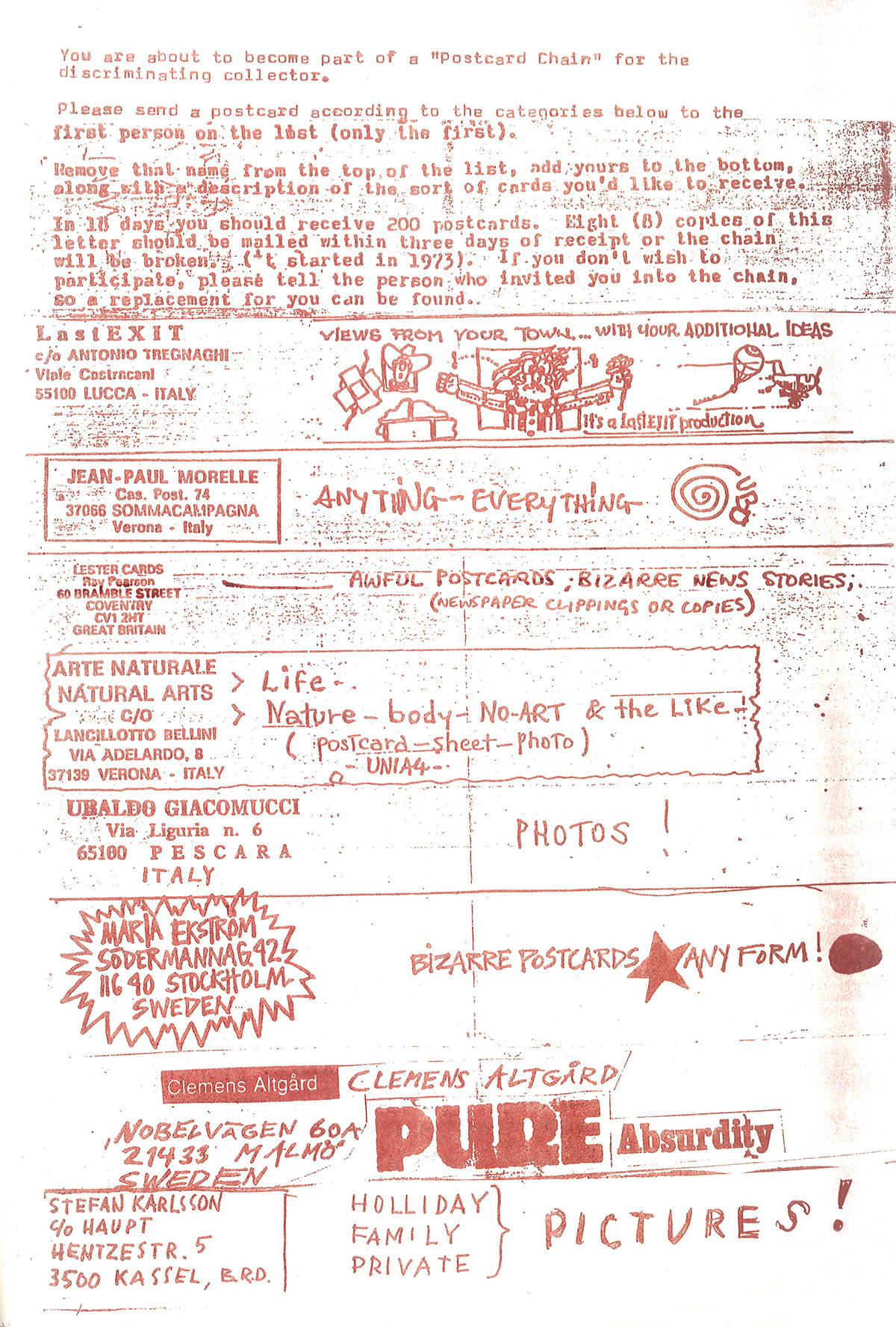
The mechanics of the project were elegantly simple and radically democratic: each participant was instructed to send a postcard to the first person on the circulating list, then reproduce the entire document in eight copies — adding their own name and postcard preferences to the bottom, while removing the top entry — and dispatch these copies to eight further participants. The promised outcome, stated with characteristic Mail Art bravado, was the receipt of approximately 200 postcards within two to three weeks.
What elevates this project above an ordinary chain letter is its artistic self-consciousness. The document does not merely facilitate exchange; it documents the network itself. Each iteration layers new names, addresses, rubber stamps, hand-drawn vignettes, and idiosyncratic statements of postcard interest atop the previous ones, producing an ever-thickening archive of the international postal community.
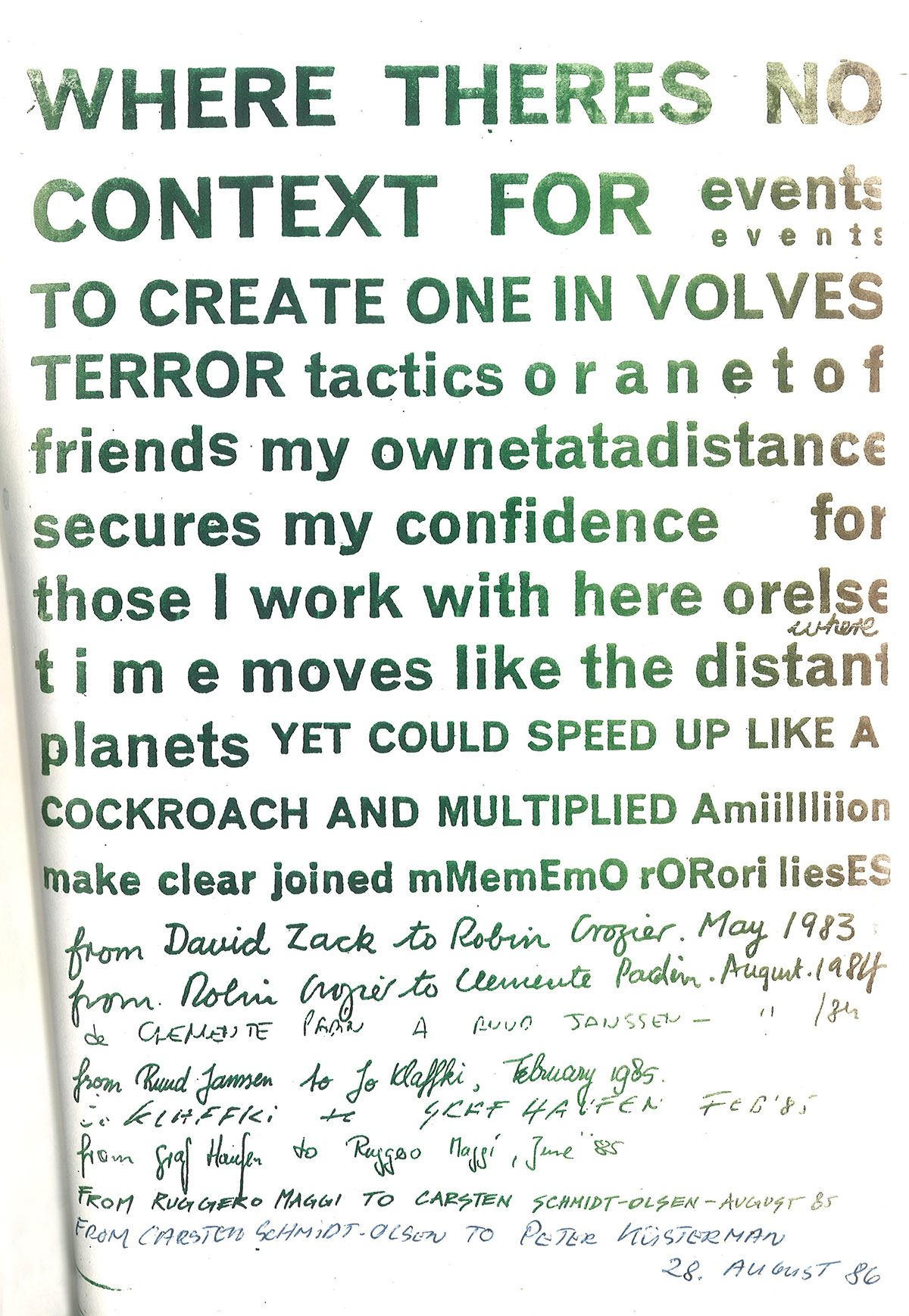
The last page of the publication — a typographically dense text artwork — records one chain's traceable journey across more than three years and nine countries: from David Zack (May 1983) to Robin Crozier (August 1984), then to Clemente Padín (November 1984), Ruud Janssen (February 1985), Jo Klaffki (February 1985), Graf Haufen (June 1985), Ruggero Maggi (August 1985), Carsten Schmidt-Olsen (August 1985), and finally to Peter Küsterman on 28 August 1986 — the date at which the Artpool copy's documented chain ends. The participants span Hjørring, Sunderland, Montevideo, Breda, Germany, Italy, and beyond, making the document a microcosm of Cold War-era international artistic correspondence, crossing the Iron Curtain via Michael Groschopp of Magdeburg (DDR).
Carsten Schmidt-Olsen, born in 1952 and based in Hjørring in northern Denmark, was introduced to Mail Art by Yoshio Nakajima in 1979 and subsequently became an active concept artist working across painting, graphic design, photography, video, performance, and the postal network. His role in this project — as compiler, printer, binder, and conduit — is exemplary of his broader practice of transforming network exchange into tactile, printed objects.
The text artwork on the provenance page — beginning "WHERE THERES NO CONTEXT FOR events / TO CREATE ONE IN VOLVES TERROR tactics" — reads as a poetic manifesto for the networked, rhizomatic logic of chain-letter art: context is created not by institutions but by the cumulative act of friends passing documents across distances, with "time mov[ing] like the distant planets."