Shozo Shimamoto (1928–2013), a founding member of the Japanese avant-garde collective Gutai (established Osaka, 1954), became one of the most internationally networked mail artists of the 1980s and early 1990s. His distinctive practice centred on the use of his own shaved head as a medium and canvas — a living, mobile surface for messages, paintings, and performances that he carried across continents. The publication Shozo Shimamoto Networking, issued on 1 December 1990 by Art Space in Nishinomiya, Japan, serves as the primary document of this decade-long global networking trajectory.
The catalog is conceived not as a conventional exhibition record but as a personal chronology and manifesto of networked activity: it combines documentary photographs, press clippings, bilingual texts (Japanese and English), autobiographical essays, and a detailed personal history spanning 1947 to 1990. The cover features a mail artwork by Ray Johnson — a silhouette of Shimamoto's head viewed from behind — establishing from the outset the symbolic centrality of Shimamoto's head to his artistic identity and to the international postal network.
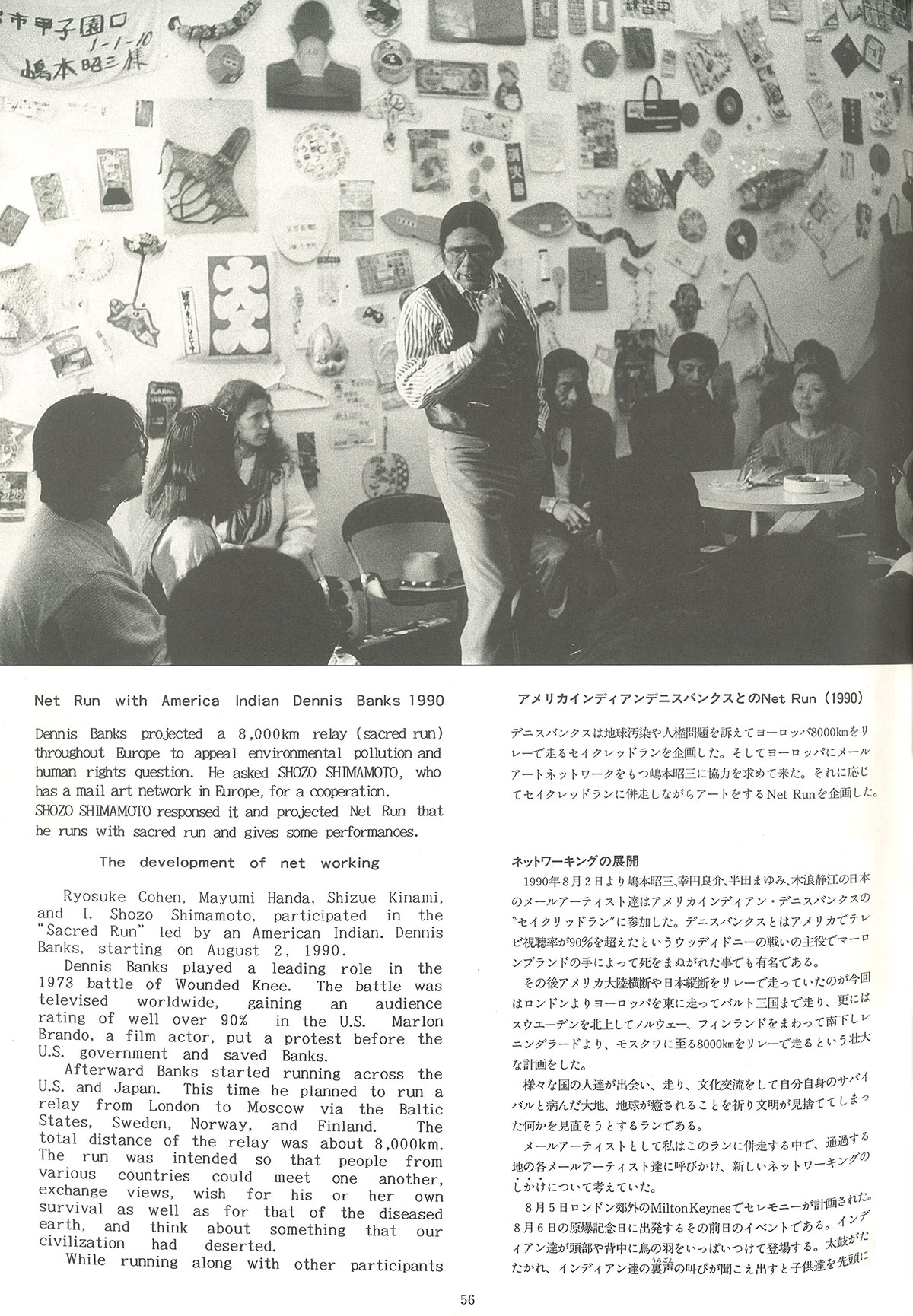
The socio-political context is essential. Shimamoto's networking practice emerged in the Cold War years with a profoundly pacifist orientation rooted in Hiroshima's legacy. From his collaboration with atomic bomb survivor Bern Porter to his participation in the "Sacred Run" peace relay led by Native American activist Dennis Banks in 1990 — a relay stretching from London to Moscow via the Baltic States — Shimamoto consistently deployed mail art as a diplomatic instrument aimed at bridging national, cultural, and ideological boundaries. His philosophy of "AU" (Artist Union / Art Unidentified) — a continuation of Gutai's anti-hierarchical spirit — held that all artistic contributions, however modest, carried equal value, much as every organism in a tropical rainforest sustains the whole ecosystem. This ecological metaphor, articulated by Shimamoto in several texts reproduced in the catalog, became a cornerstone of his mail art philosophy.
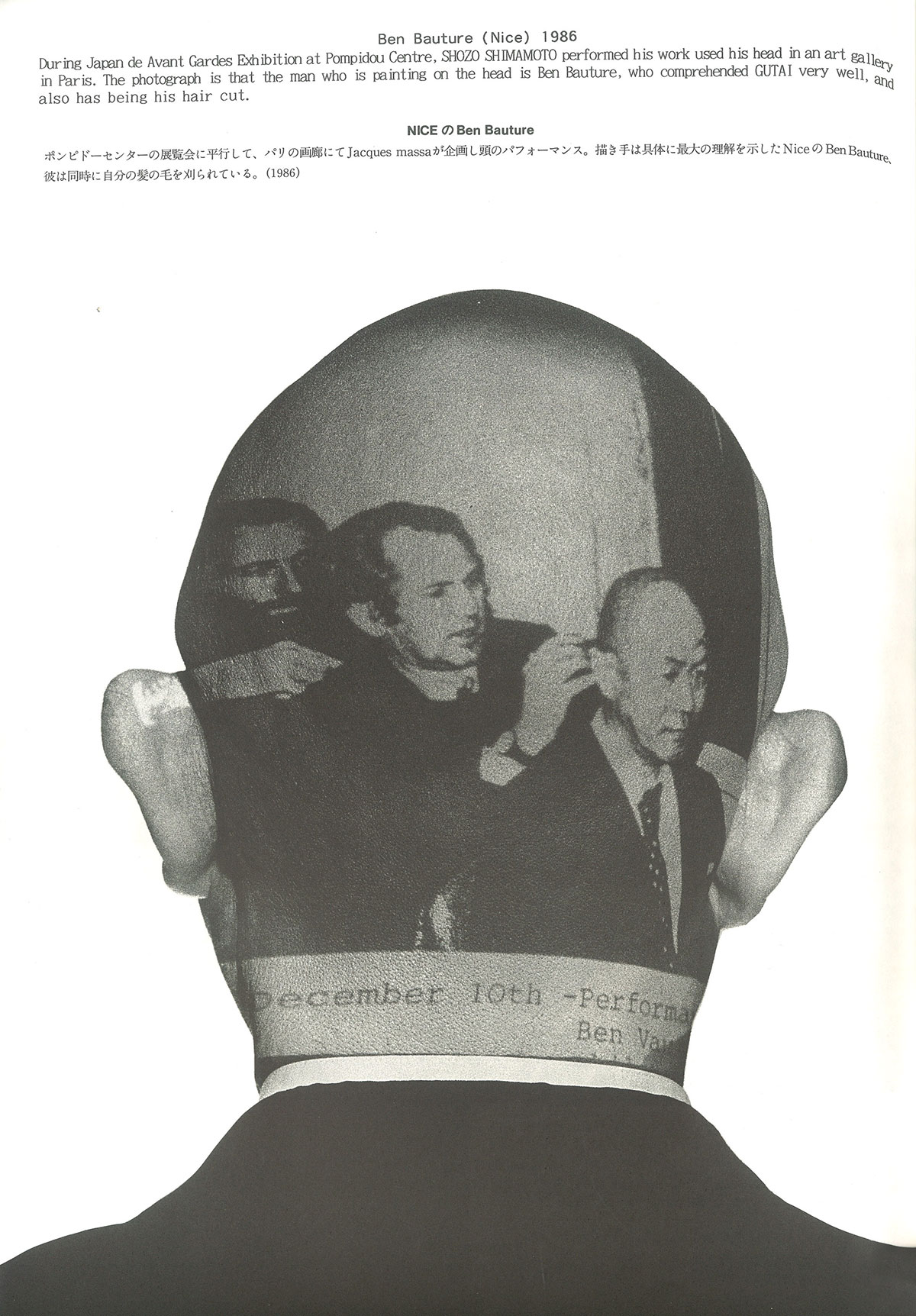
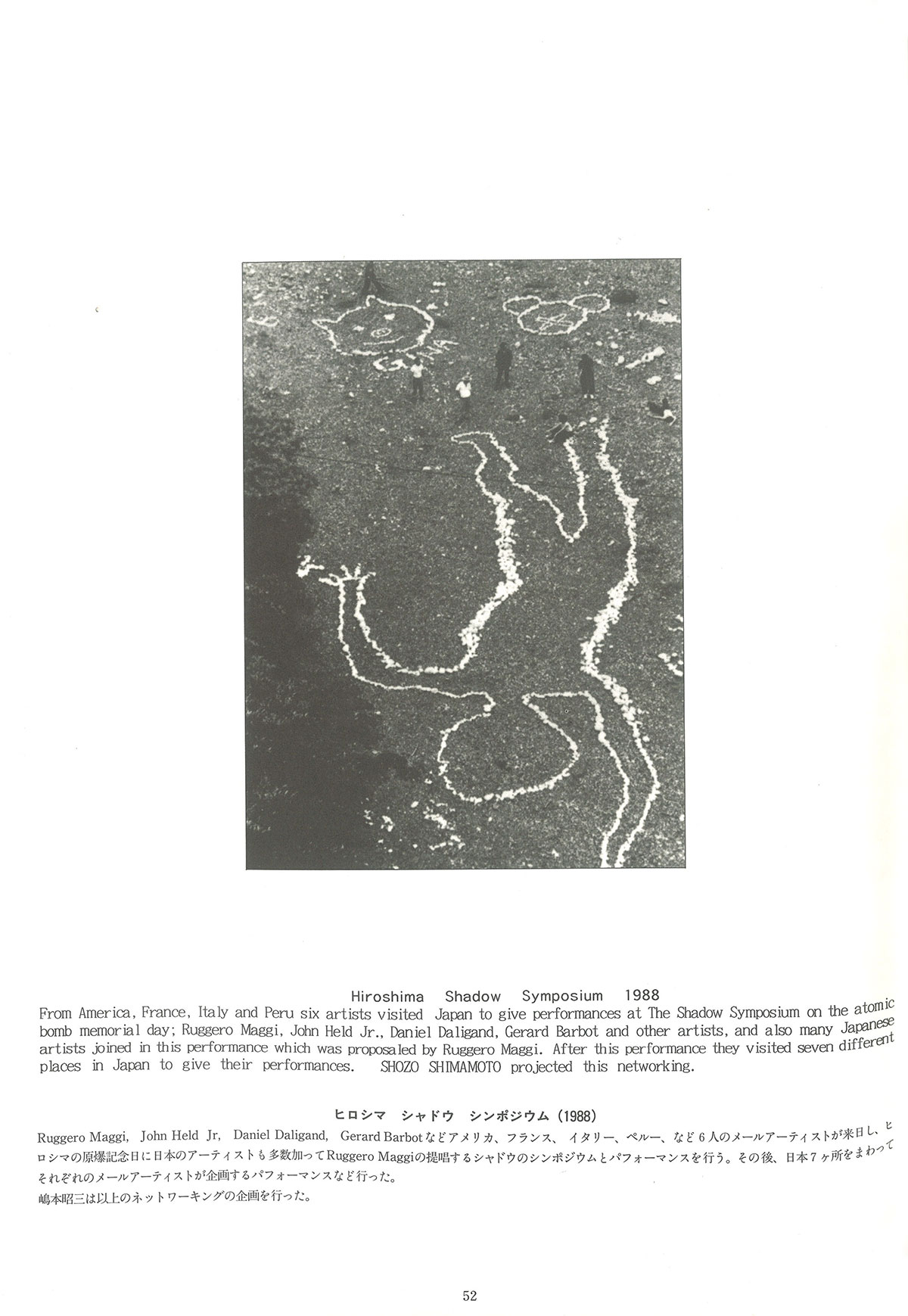
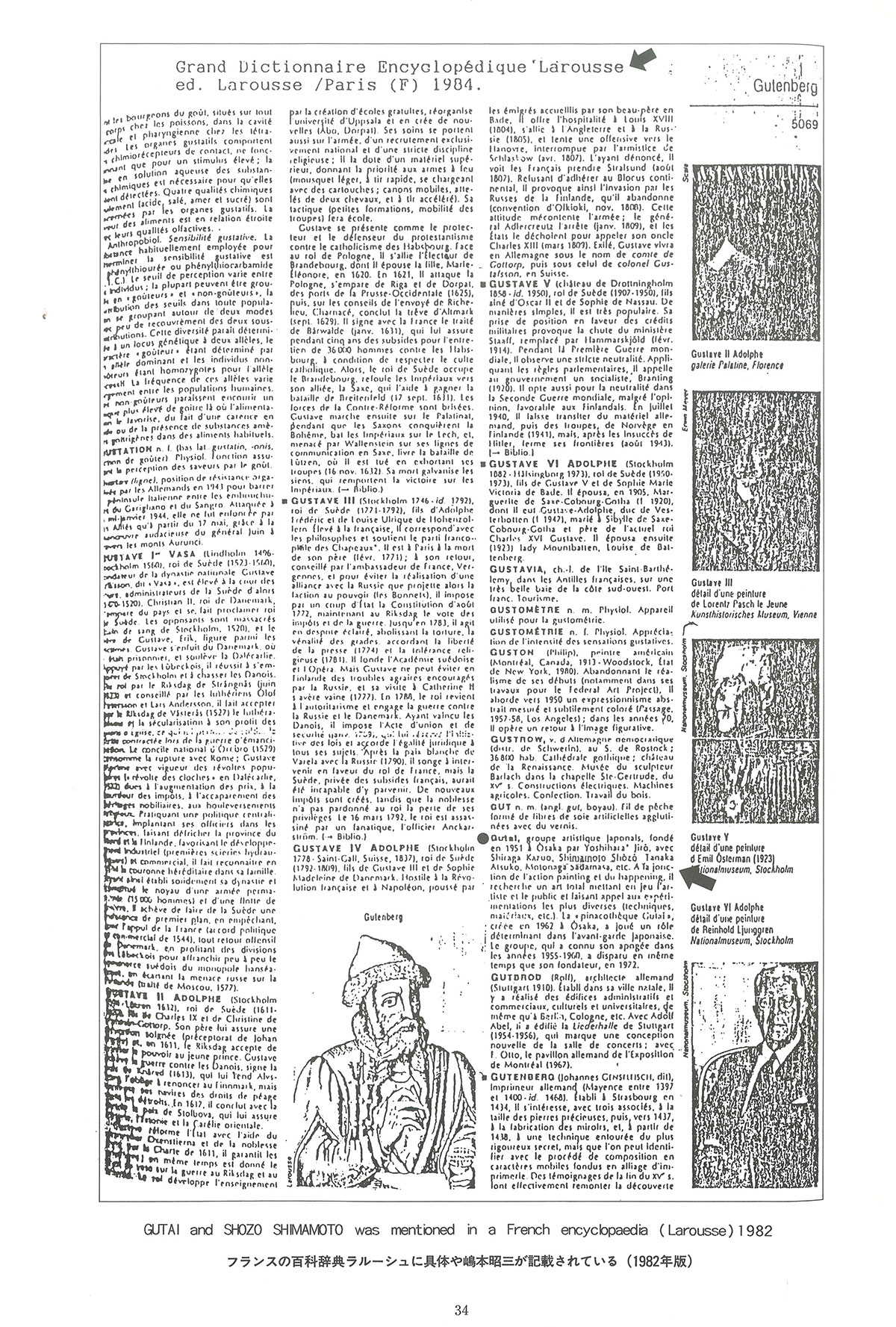
The catalog documents key networking episodes: inclusion in the Grand Dictionnaire Encyclopédique Larousse (Paris, 1984); the Japan de Avant Gardes Exhibition at the Centre Pompidou, Paris (1986), where Ben Vautier (Nice) performed on Shimamoto's head; the exhibition at the Museum of Brazilian Art, São Paulo (Fundação Armando Álvares Penteado, 1986), co-organized with Pierre Restany, Bruno Talpo, and Daisy Pellinini; the Hiroshima Shadow Symposium (1988), with Ruggero Maggi, John Held Jr., Daniel Daligand, and Gérard Barbot; and the "Sacred Run" collaboration with Dennis Banks and Ryosuke Cohen (1990). A full personal chronology (1947–1990) and an essay on the origins of Gutai by Shimamoto, republished from Light Works (America, 1984), complete the publication.
Multiple international mail artists named throughout the catalog :G.A. Cavellini, Ray Johnson, Bern Porter, Cracker Jack Kid, Dennis Banks, Ruggero Maggi, John Held Jr., Daniel Daligand, Gérard Barbot, Ryosuke Cohen, Mayumi Handa, NATO, Charles Francois, B.E. Pilcher, Klaus Groh, Heino Otto, Nam June Paik, Daniel Spoerry, Giuseppe Chiari, Pierre Restany, Walter Zanini, Mario Craro Heto, Joseph Beuys, Antonio Parudiso, Walter de Maria, Bruno Jalpo, Daniel Buren, Eugenio Kiccini, Fugenio Piessi, Lamberto Pignotti, Mario Nigro, Grupo Metamorfosi, Daisy Pellinini, Bruno Tarpo, Paul Summer, James Bailey, Isabelle Dervaux, Mark Bloch, among many others.
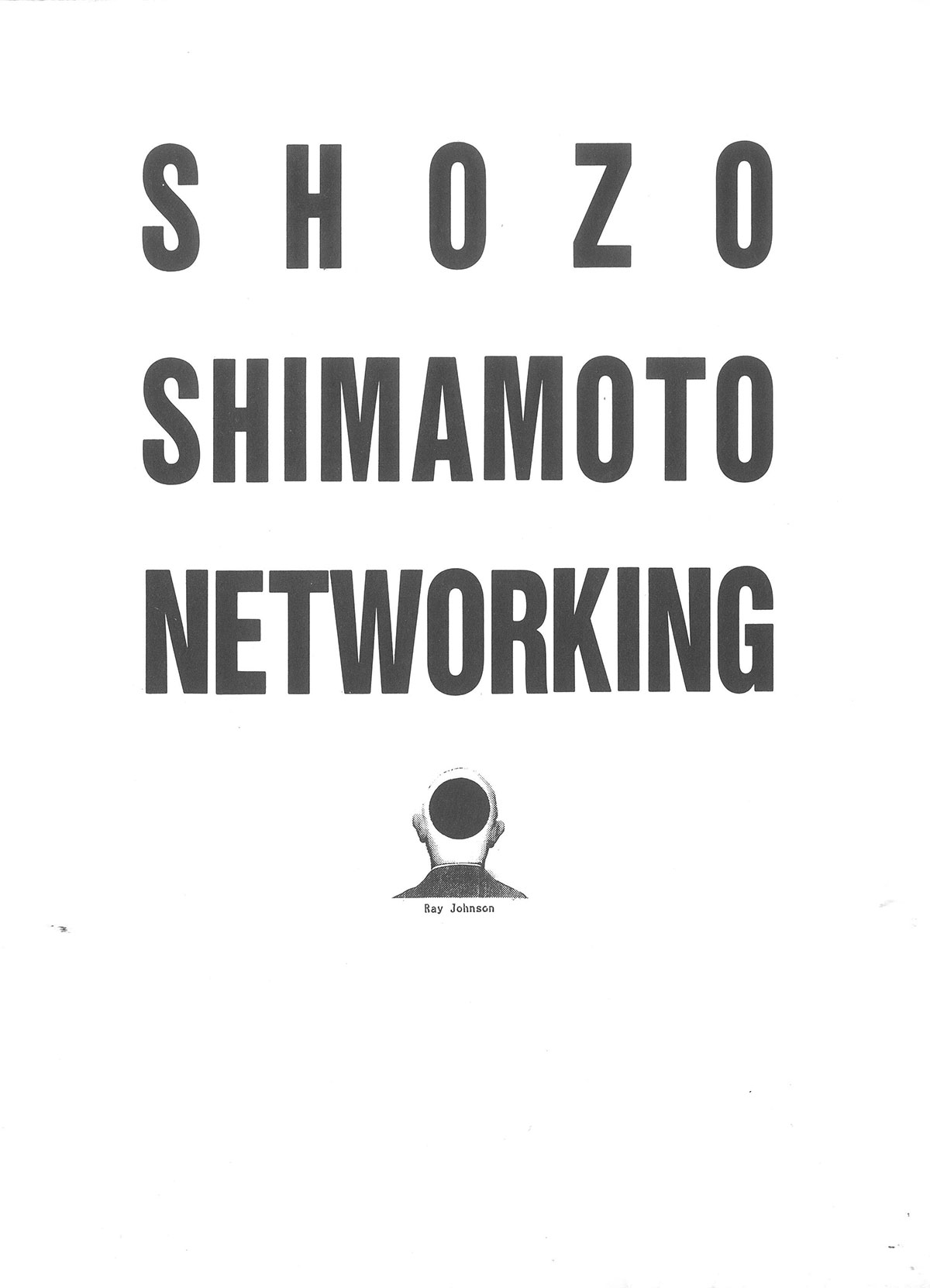
Cover. Work by Ray Johnson — depicting the back of Shimamoto's bald head — captioned with Johnson's name.

A reproduction of the "Gutai" entry in the Grand Dictionnaire Encyclopédique Larousse (Paris, 1984), with a caption noting that "Gutai and Shozo Shimamoto was mentioned in a French encyclopaedia (Larousse) 1982."

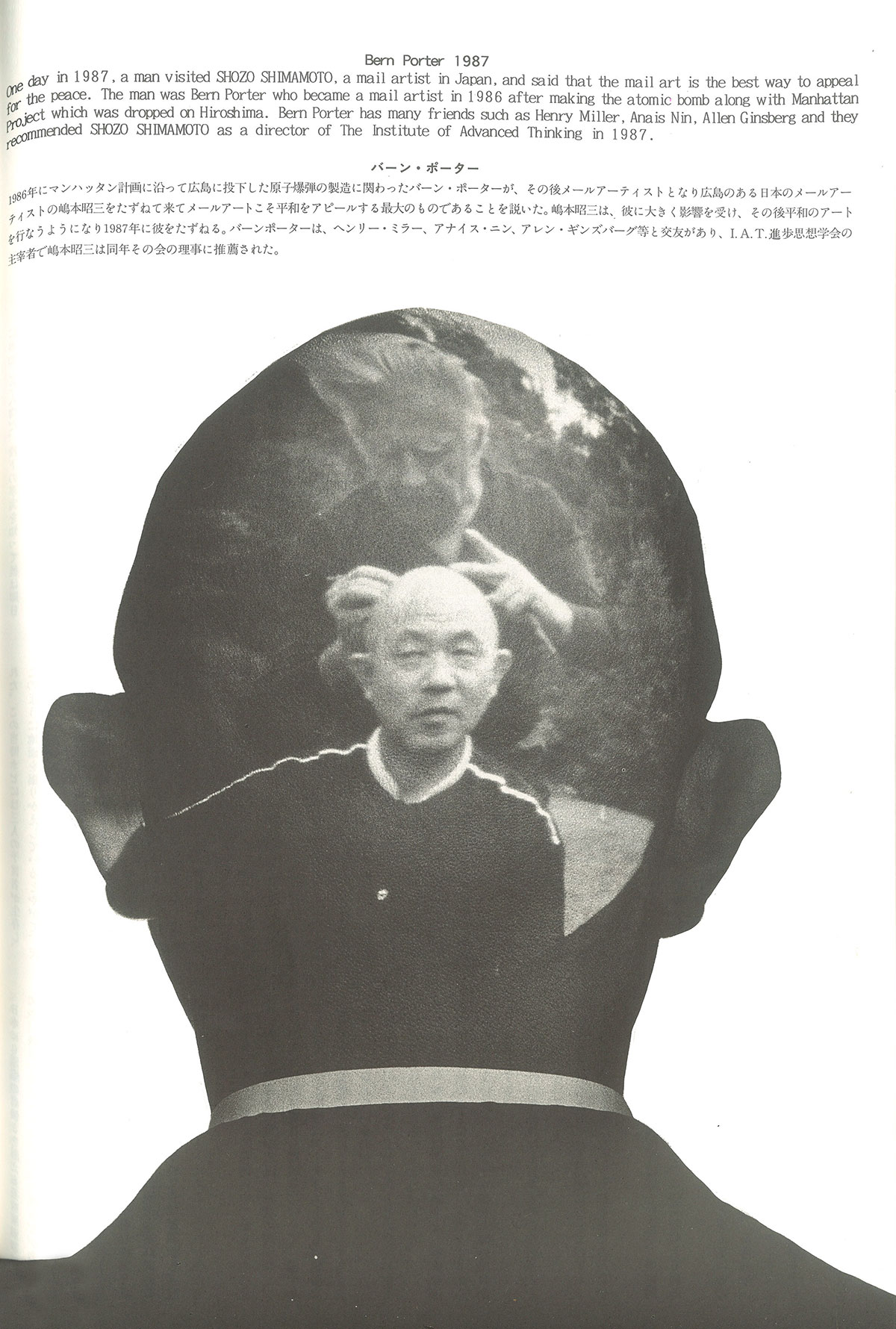
Bilingual text and photographic portrait documenting "Bern Porter 1987" — the moment Bern Porter, maker of the Hiroshima atomic bomb, visited Shimamoto in Japan and became a mail artist; Porter subsequently recommended Shimamoto as a director of The Institute of Advanced Thinking.


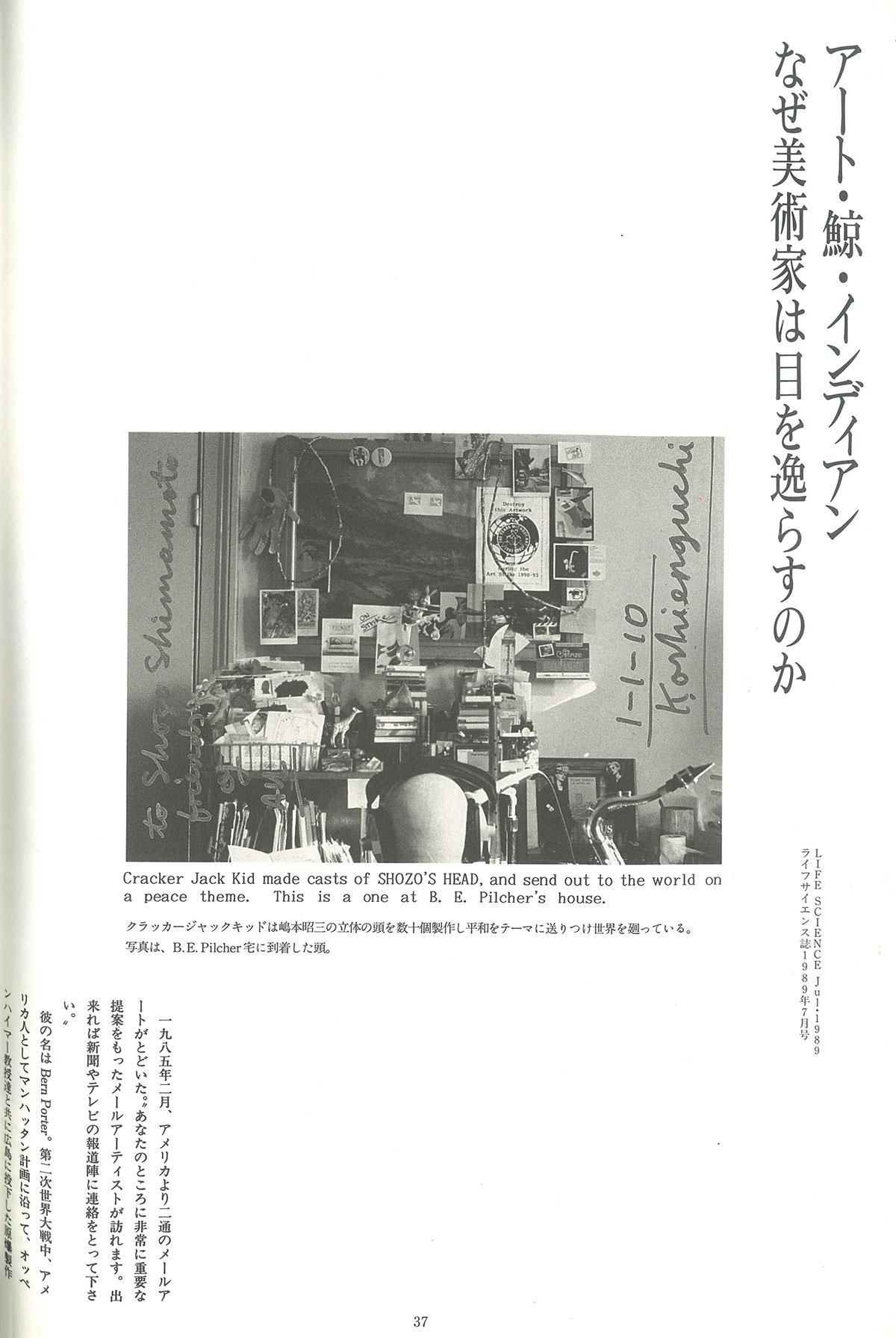
Pages 36–37. Bilingual spread (Japanese and English). Title in Japanese reads "Art — Whale — Indian: Why do artists avert their eyes?" A caption records that Cracker Jack Kid made casts of Shimamoto's head in plaster and sent them to his correspondents on a peace theme.

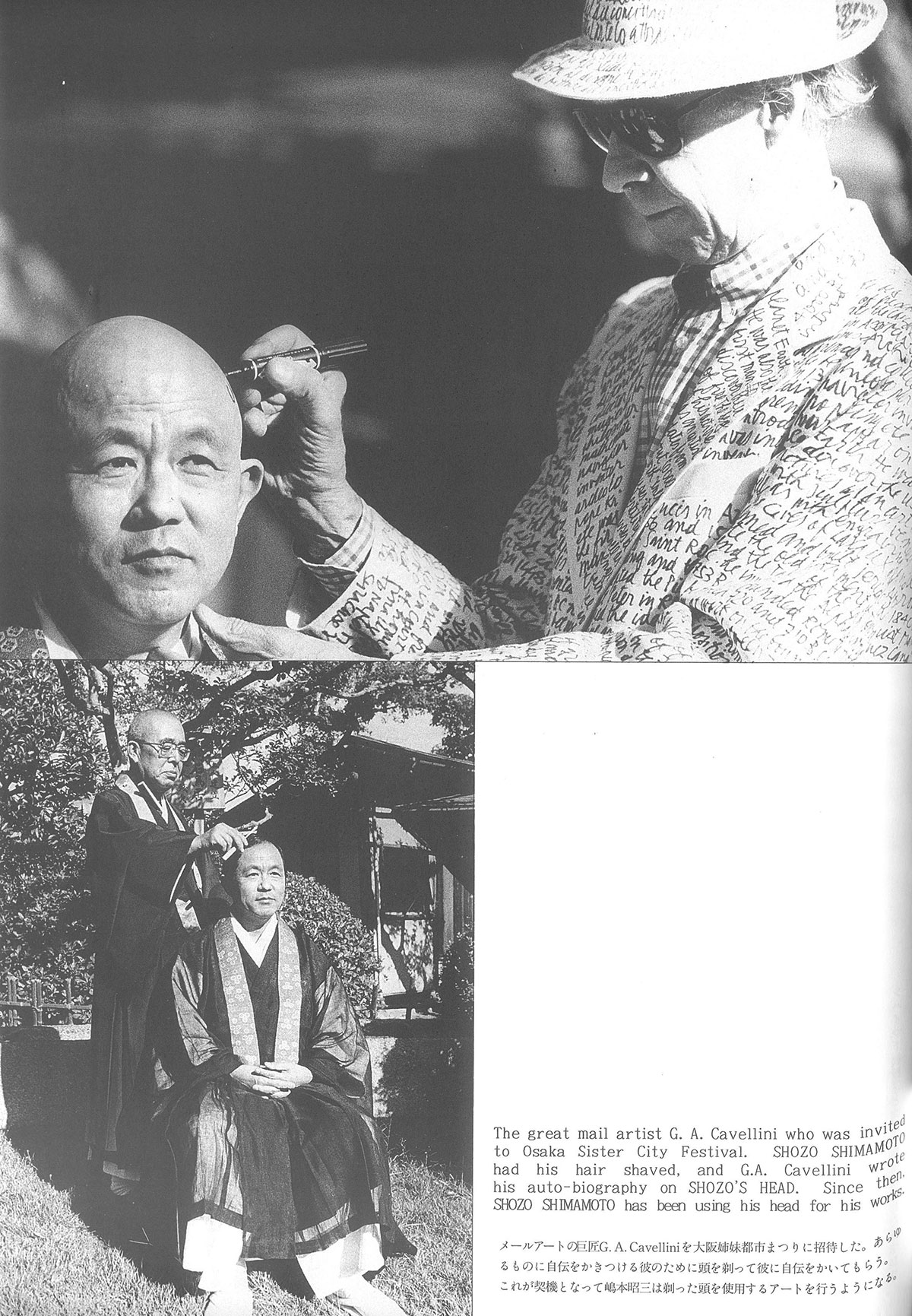
Three photographs showing Italian mail artist G.A. Cavellini writing his autobiography on Shimamoto's shaved head at the Osaka Sister City Festival — the moment that prompted Shimamoto to begin using his head as a permanent artistic medium.

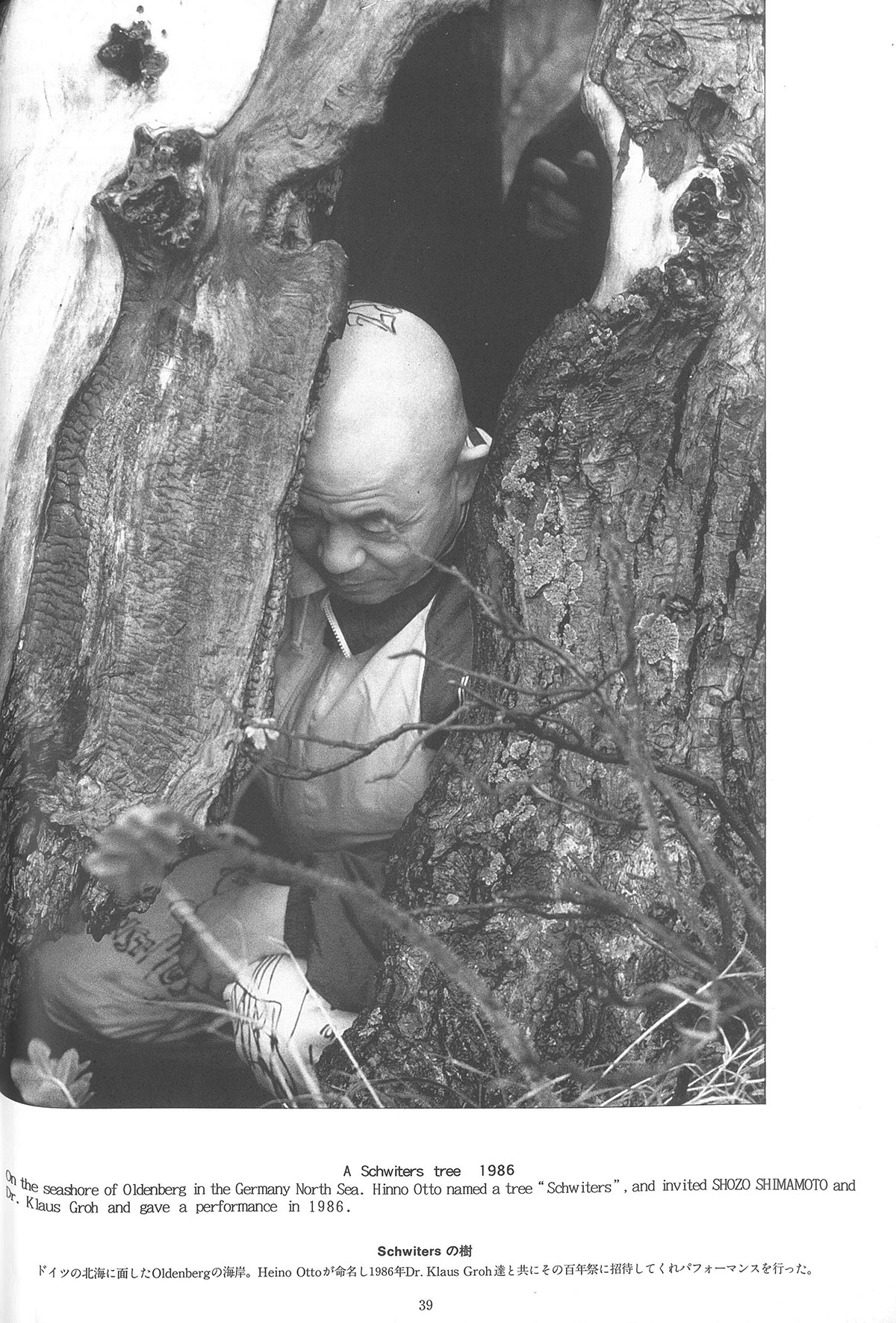
A large photograph of Shimamoto with his head inserted into the hollow of a tree — documented as "A Schwiters Tree, 1986" — at the seashore of Oldenburg (Germany North Sea), at an event organized by Heino Otto, with Dr. Klaus Groh also present.

During the Japan de Avant Gardes Exhibition at the Centre Pompidou, Paris, 1986, Shimamoto performed with his head as canvas, with Ben Vautier painting on it.

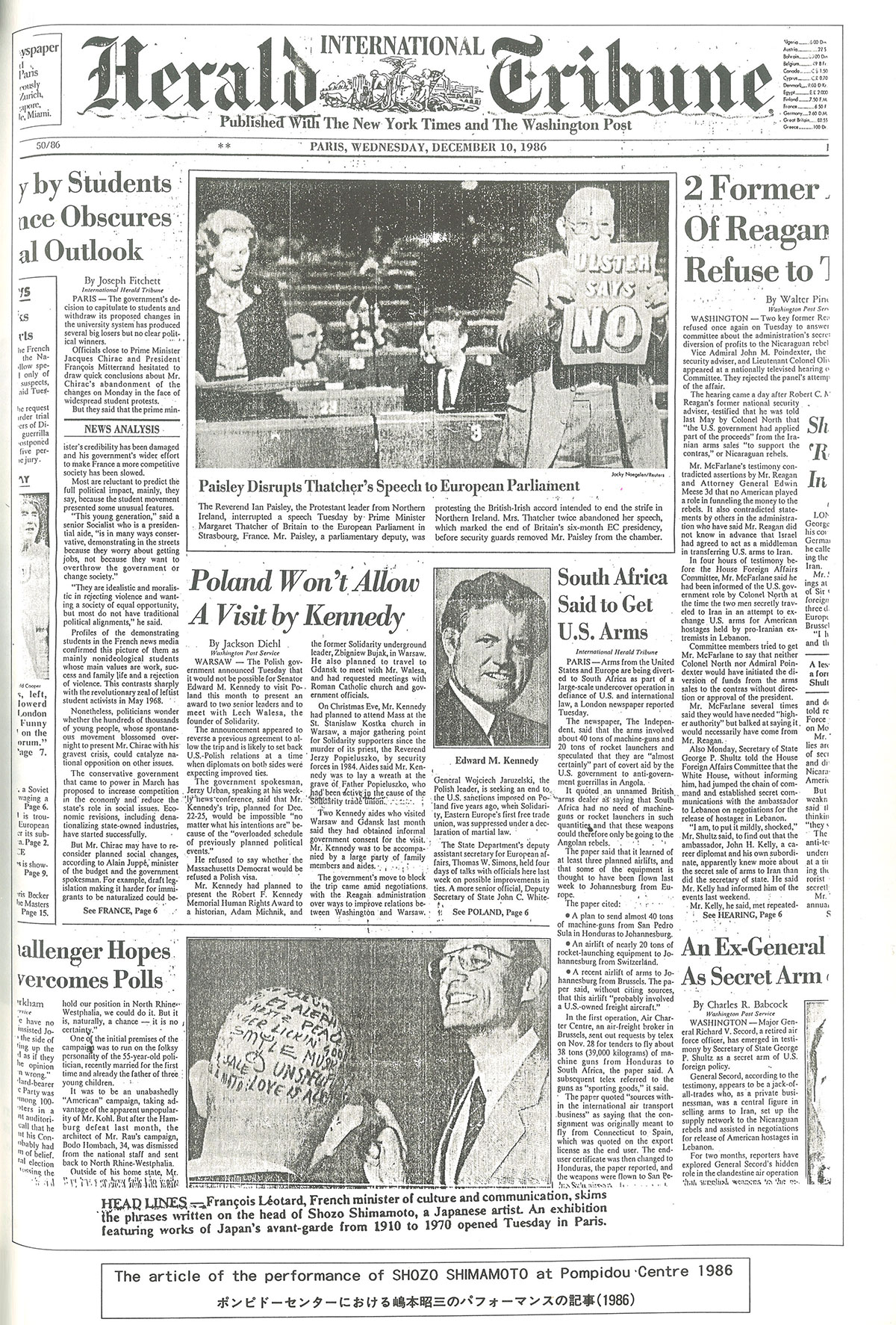
A full reproduction of the International Herald Tribune (Paris, Wednesday, 10 December 1986) showing Shimamoto's silhouetted head in the foreground of the front page, with a caption noting that French Minister of Culture and Communication François Léotard read phrases written on Shimamoto's head at the Pompidou.

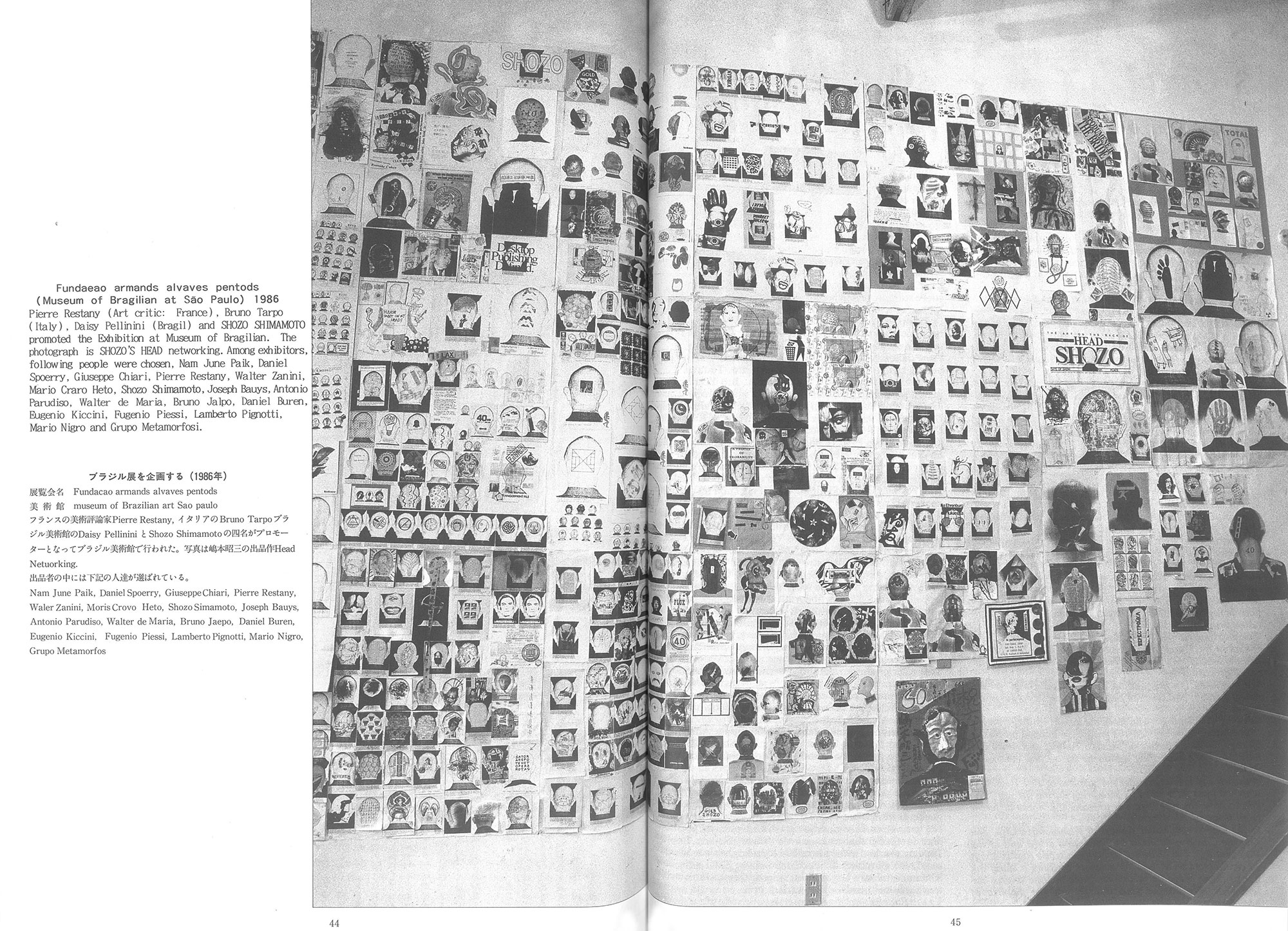
Bilingual text describing the exhibition at the Fundação Armando Álvares Penteado (Museum of Brazilian Art, São Paulo, 1986), co-organized by Pierre Restany, Bruno Talpo, Daisy Pellinini, and Shozo Shimamoto.
A full-page photograph of a densely installed exhibition wall at the São Paulo museum covered with hundreds of mail art works depicting Shimamoto's head — the "Shozo's Head Networking" installation.

text and photograph of the "Hiroshima Shadow Symposium, 1988" — from America, France, Italy, and Peru, six artists visited Japan to give performances on the atomic bomb memorial day; participants included Ruggero Maggi, John Held Jr., Daniel Daligand, and Gérard Barbot; Shimamoto organised the networking.

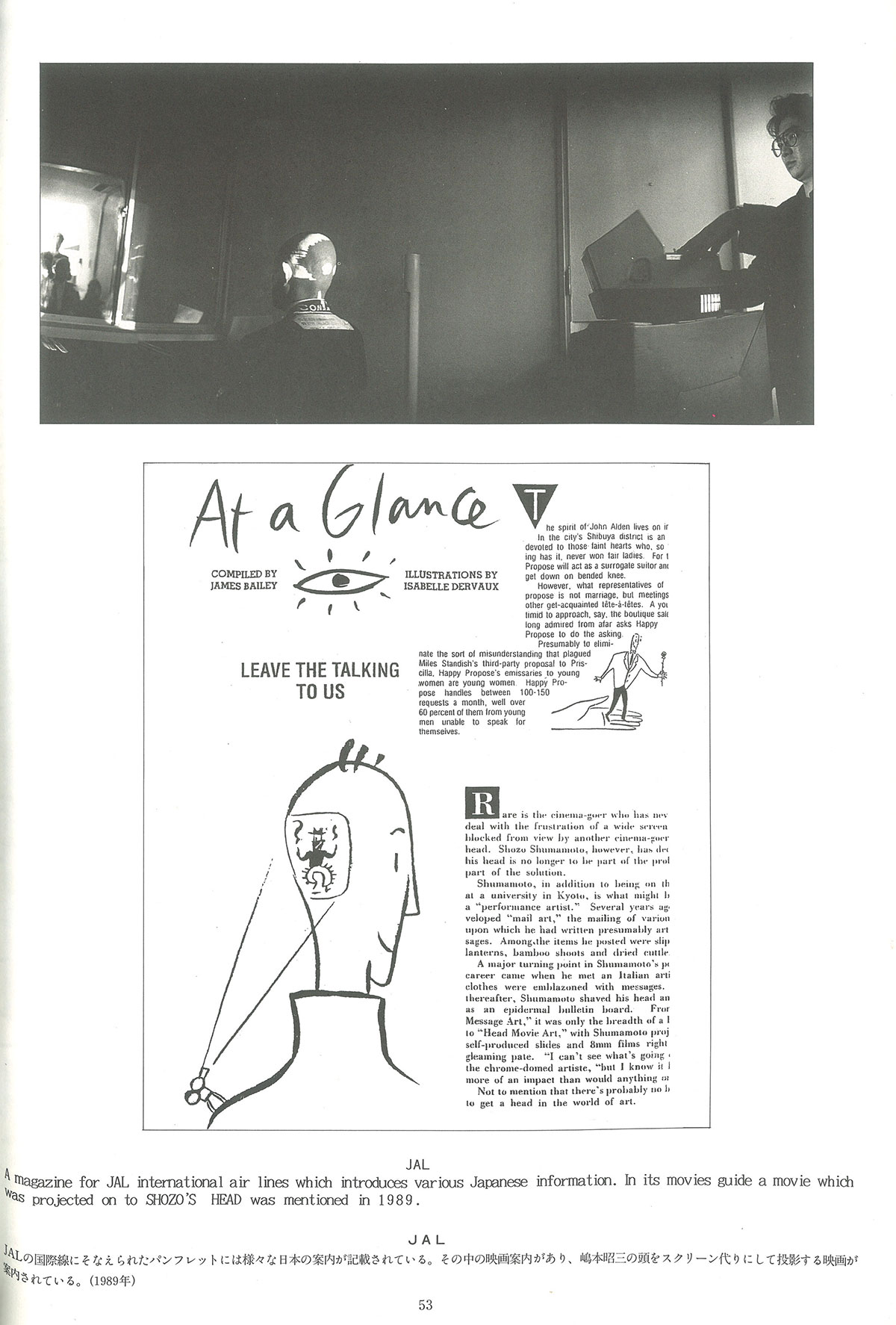
A photograph of the Head Movie Art screening. Right page (centre): a reproduction of "At a Glance" from a magazine, illustrated by James Bailey and Isabelle Dervaux, describing Shimamoto's cinema-projection-on-head practice.

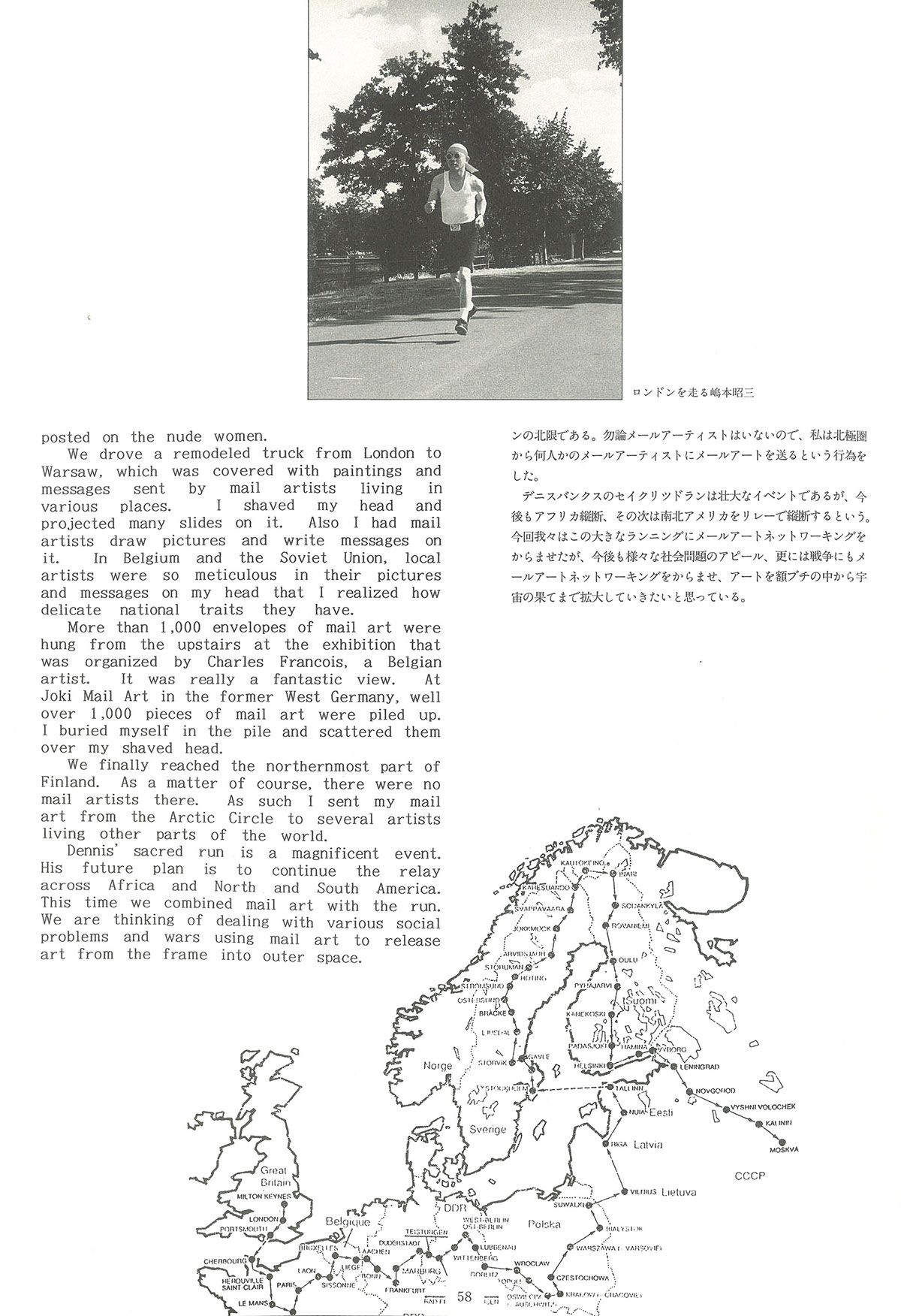
Bilingual text and photographs documenting the "Net Run with American Indian Dennis Banks, 1990" — Shimamoto, Ryosuke Cohen, Mayumi Handa, and Shizue Kinami participated in the Sacred Run across Europe (London–Moscow relay, ca. 8,000 km), combining mail art networking with Banks's peace and civil rights activism.

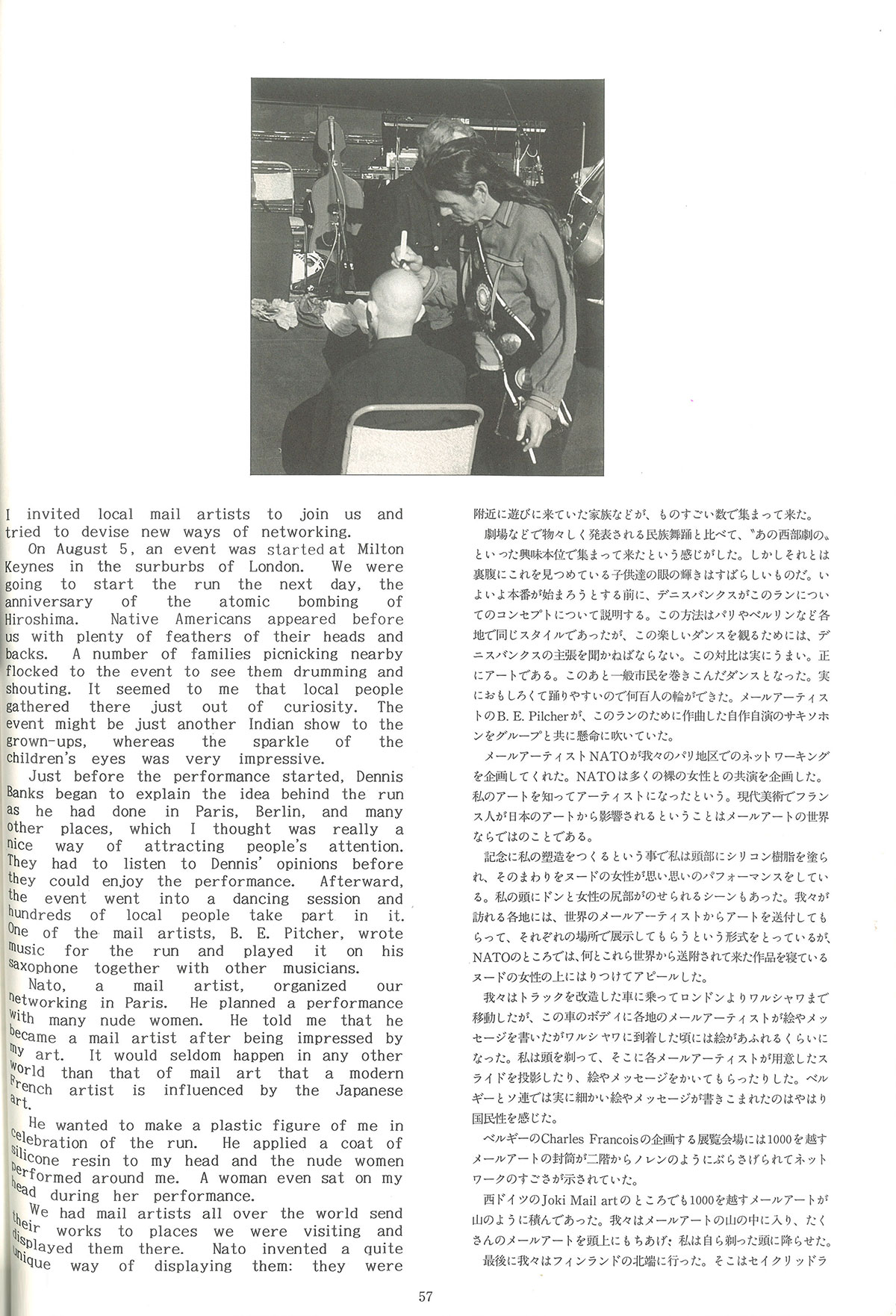
Continuation of the text in English, describing networking events in Paris (organised by NATO), London (Milton Keynes), Poland, Belgium, and Finland.

Continuation of the Sacred Run text and a photograph of Shimamoto running in London, captioned "ロンドンを走る嶋本昭三" (Shimamoto Shozo running in London). A map of Europe shows the Sacred Run relay route from London to Moscow through the Baltic states.

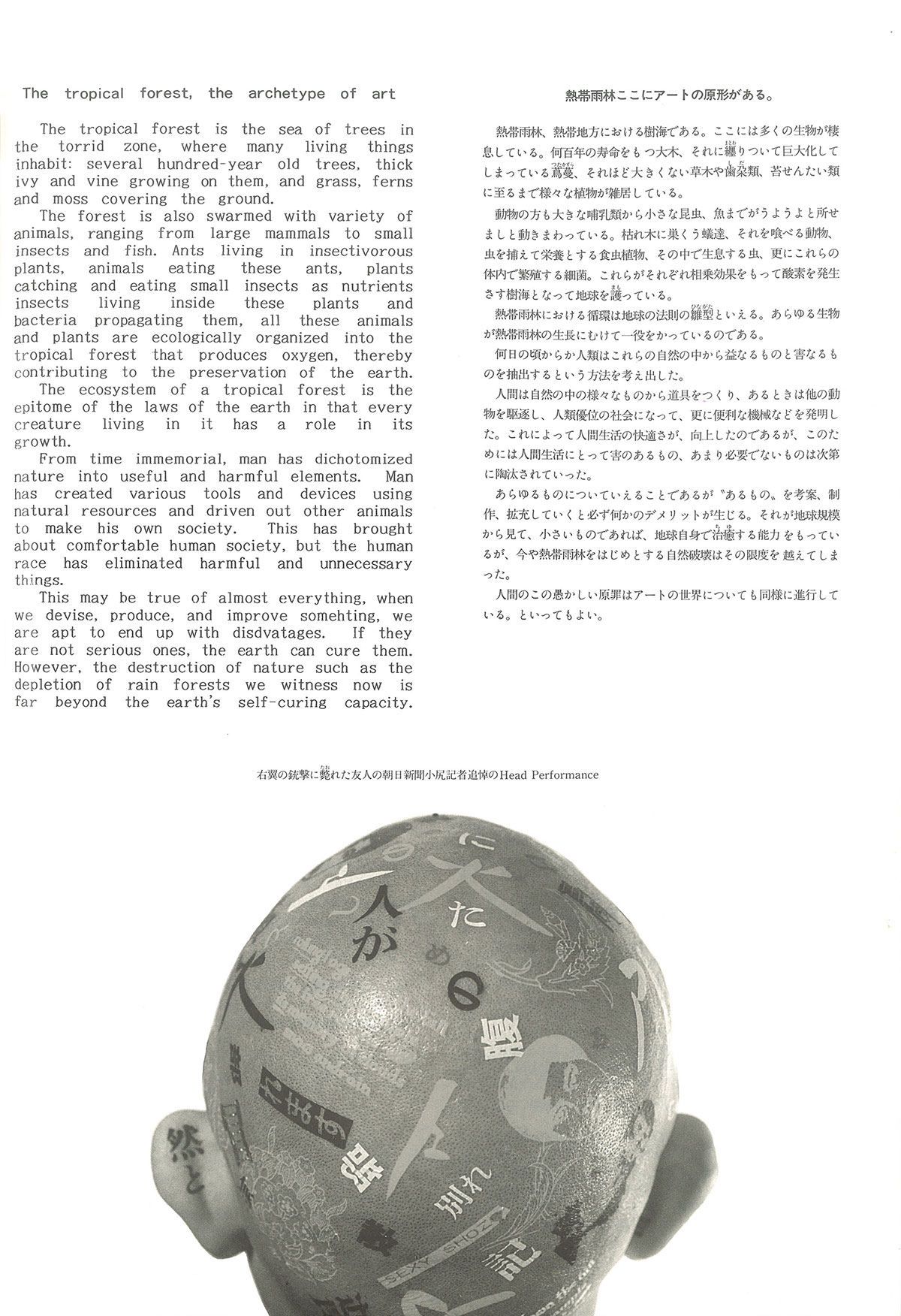
Essay entitled "The tropical forest, the archetype of art" — Shimamoto's ecological philosophy of mail art networking — in English and Japanese, accompanied by a close-up photograph of Shimamoto's head covered with Japanese characters, captioned as a performance dedicated to a friend killed by right-wing gunfire (Asahi Shimbun reporter).

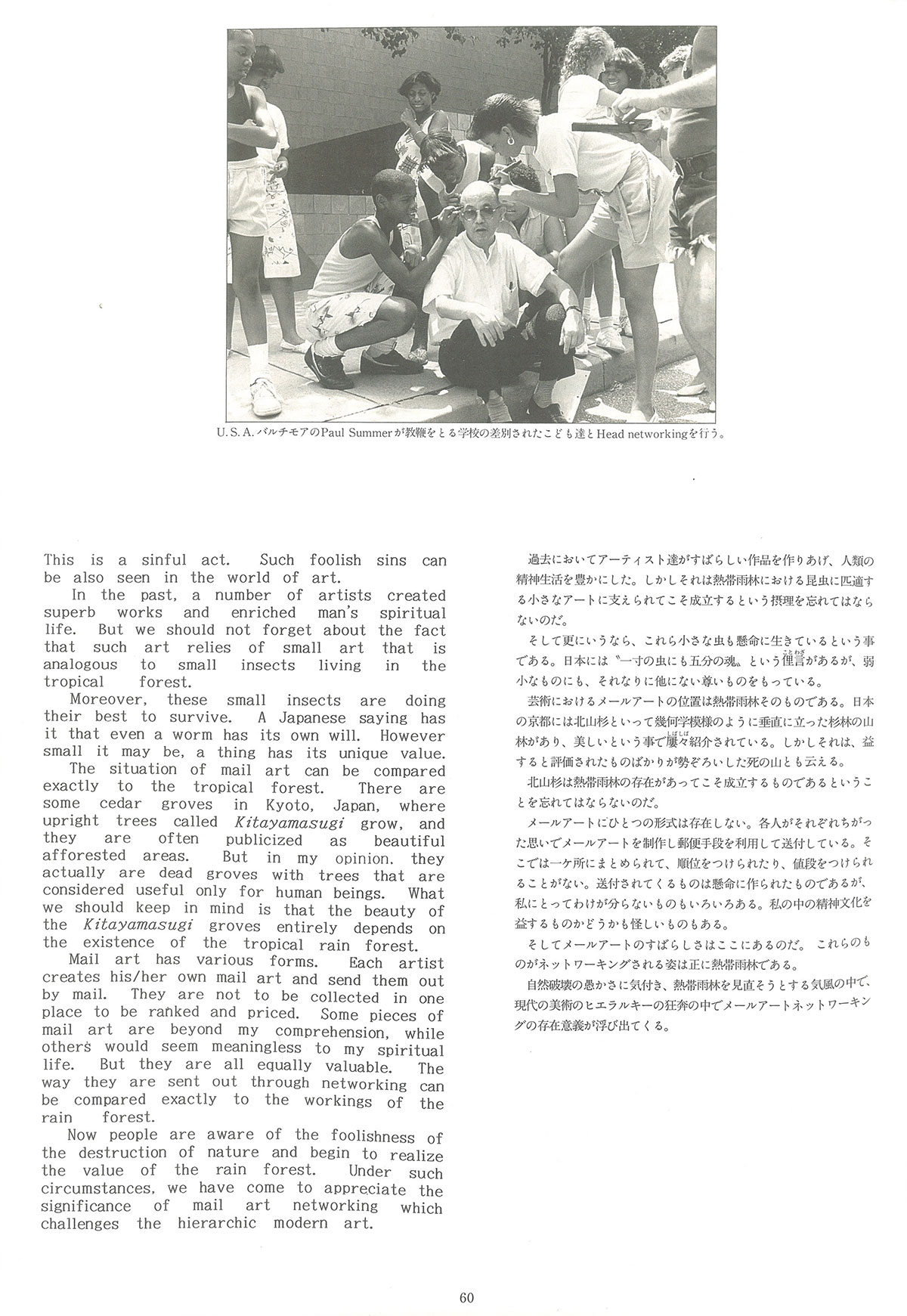
A photograph of Paul Summer (U.S.A.) performing in a school context with children in Palermo, with Shimamoto's Head Networking. Continuation of Shimamoto's essay on mail art and the tropical rainforest.

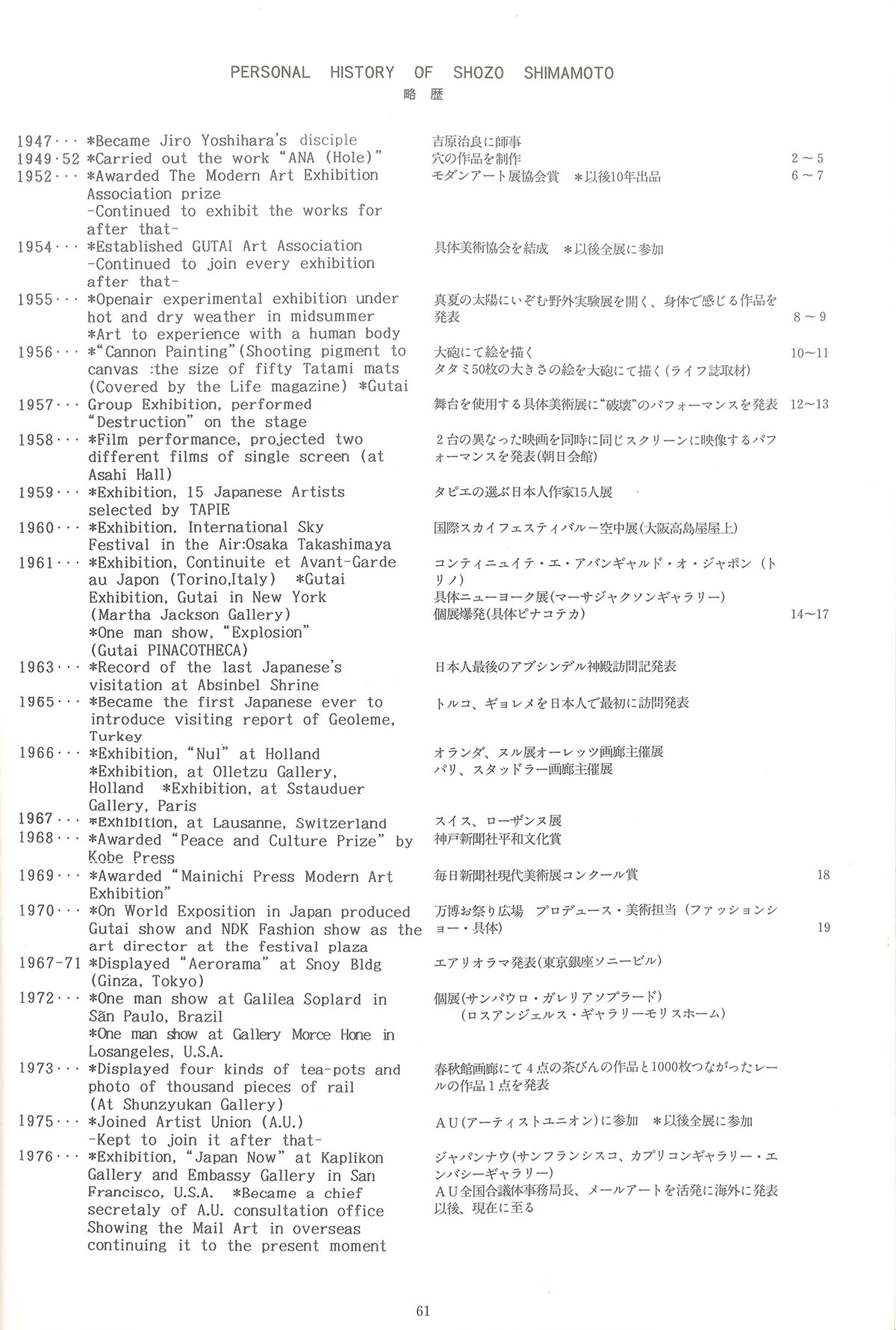
"Personal History of Shozo Shimamoto" — a detailed biographical chronology from 1947 to 1976, listing exhibitions, performances, prizes, and institutional affiliations.


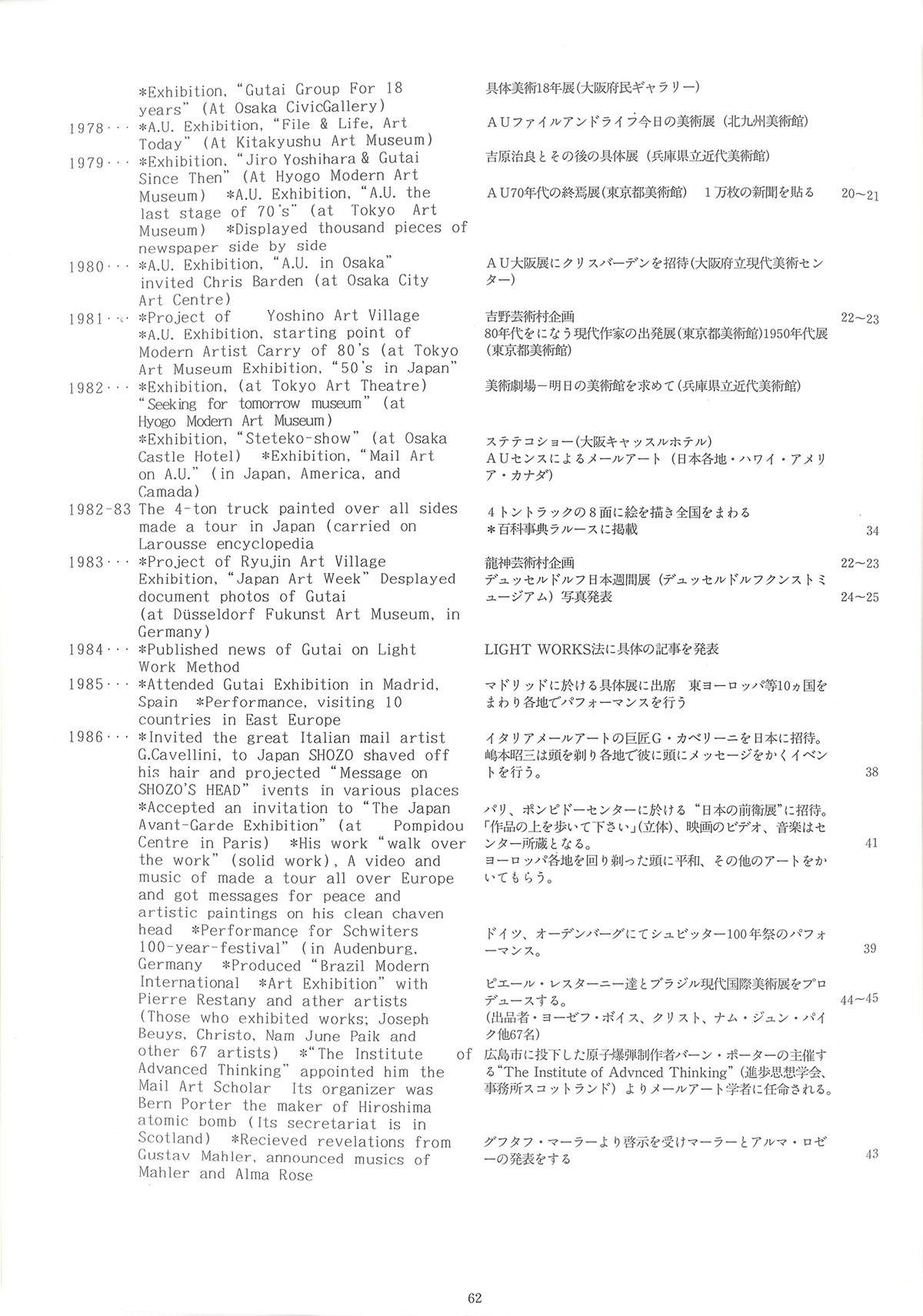
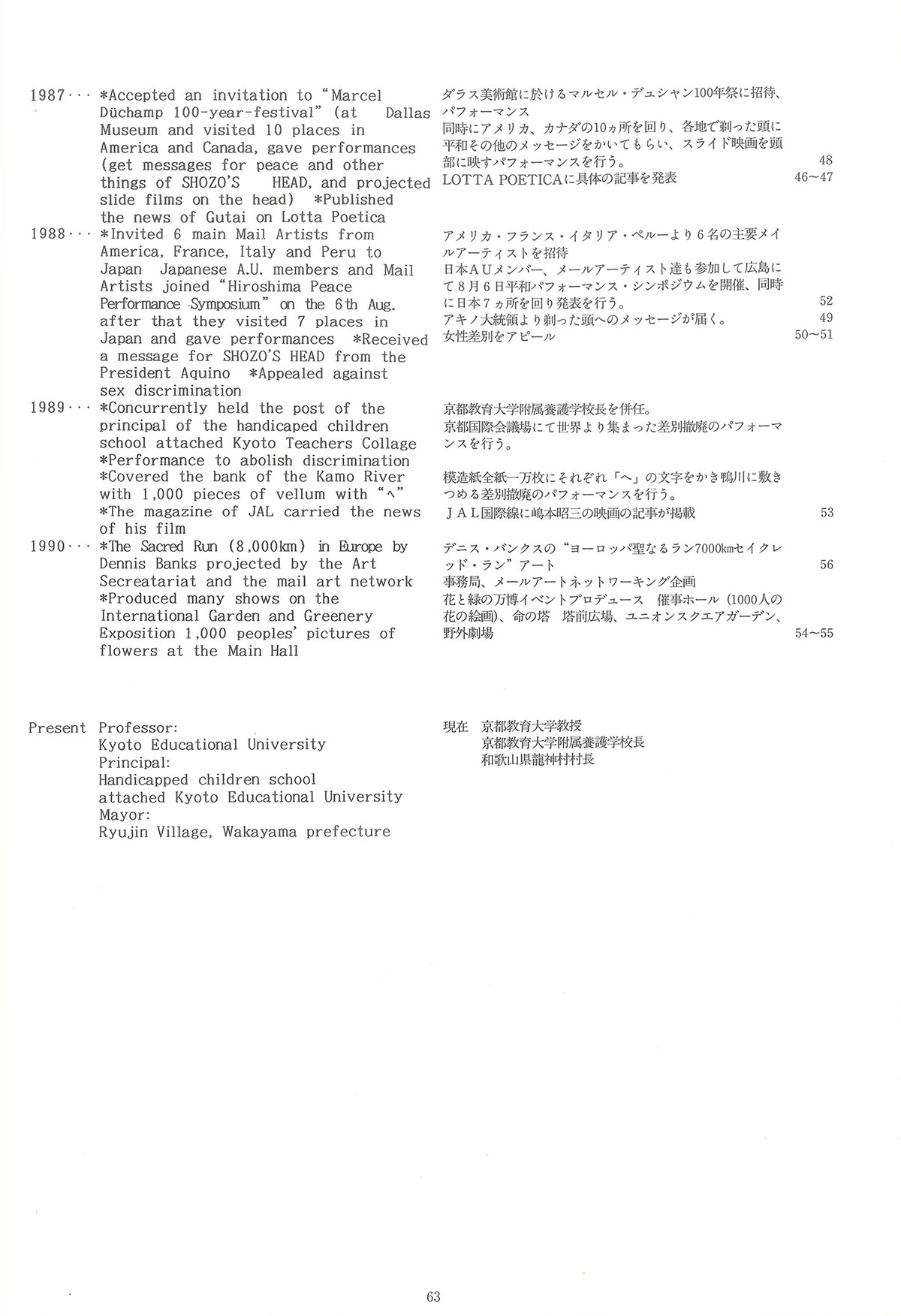
Double-page spread. Continuation of the "Personal History of Shozo Shimamoto" — chronology from 1977 to 1990, including: A.U. exhibitions in Japan; invitations to Chris Barden (Osaka City Art Centre, 1980); the four-ton painted truck tour of Japan (1982–83); Japan Art Week documentation at the Düsseldorf Fukunst Art Museum (1983); Gutai exhibitions in Madrid (1985); the G.A. Cavellini collaboration (1986); the Pompidou performance (1986); the São Paulo Brazil exhibition with 67 artists including Joseph Beuys, Christo, Nam June Paik (1986); the Marcel Duchamp 100-year-festival performance at Dallas Museum (1987); the Hiroshima Peace Performance Symposium (1988); the Sacred Run (1990); and the International Garden and Greenery Exposition (1990).

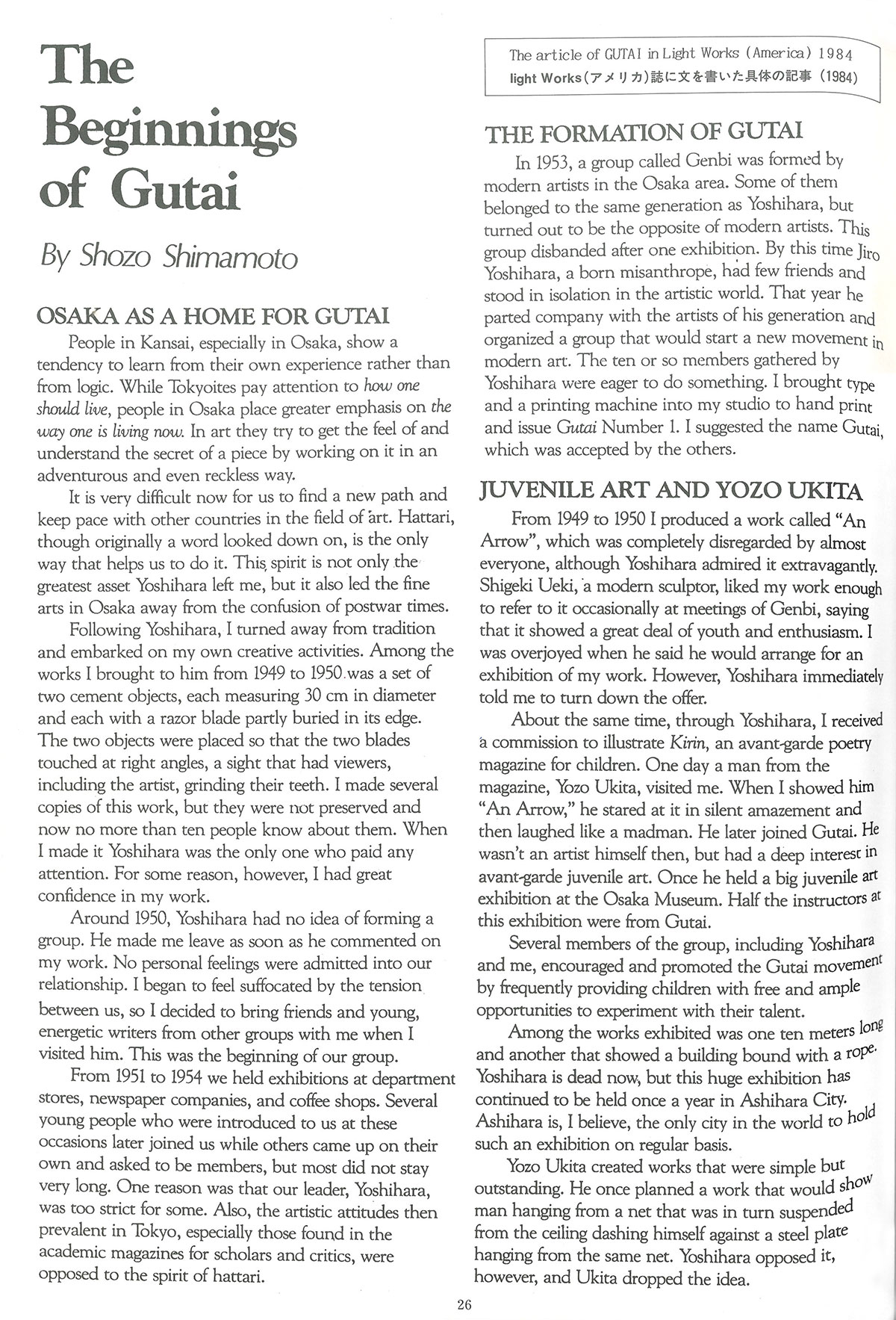
Essay "The Beginnings of Gutai" by Shozo Shimamoto — originally published in Light Works (America, 1984) — describing the formation of the Gutai group in Osaka from 1949 onward, the role of Jiro Yoshihara, the contribution of Yozo Ukita, and the group's radical anti-conventional stance. Sub-sections: "Osaka as a Home for Gutai," "Juvenile Art and Yozo Ukita," "The Formation of Gutai," "A Woman with Plaster on Her Breasts."

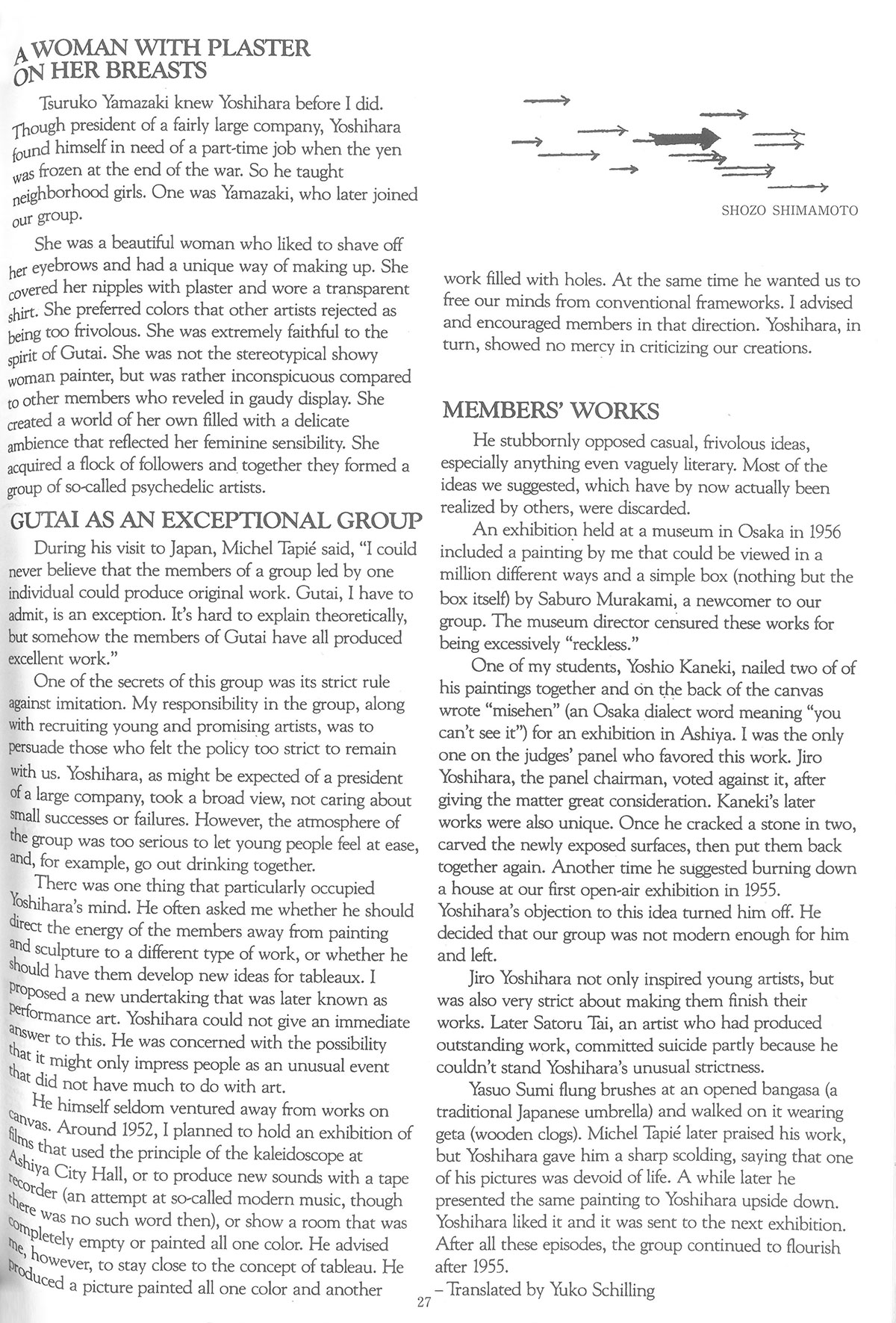
Continuation of the essay, with sections on "Gutai as an Exceptional Group" and "Members' Works," describing the group's philosophy of non-imitation and experimentation. An arrow diagram attributed to Shimamoto is visible at top right.