... we should depart from the principle that we are modes of junctions, rather than individuals.
In other words, “I” is a word that others pronounce as “you”.
Thus, we are dealing with a function word:
“I” is the “you” of the other person. Or: in defining my own identity, first of all I must distinguish myself. Parity and disparity are interdependent notions.
The same can be found in psychoanalysis, neurophysiology and neuropsychology.
These all point to the same direction. At the heart of telematics is a type of anthropology that does not perceive the human person as an individual, but rather as the manner how systems of relations function; as the realization of possible links. The intersubjective field is a virtual space in which an individual is a node in the net, inasmuch as materiality is a node in the energetic space.
A call to participate in the autumn research project at Artpool
THE EXPERIMENTER
& THE ART OF PERCEPTION
The Understanding of Freedom in the Correlation of the Apparatus and the Functionary.
Starting from the photographic situation, Vilém Flusser termed the camera as an apparatus and the photographer (the experimental photographer) as a functionary.
In his book, Towards a Philosophy of Photography, he described his expansion on this model, to arrive at an explanation of human freedom within the universe of photography (in the post-industrial context).
The so-called experimental photographer (the functionary) is truly aware that the underlying concepts, such as “image”, “apparatus”, “program”, “information”, are the fundamental problems s/he has to tackle. A philosophy of photography is needed in order for this photographic practice to be brought to the level of consciousness, which is, in turn, required, since in this practice, at least, a model of freedom manifests itself, in a post-industrial context.
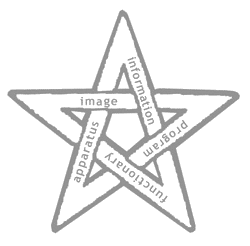
As usual in Artpool’s practice, the participants of the project are
not constrained in terms of genre, medium or otherwise;
submitted materials, after having been displayed
at the exhibition/event in Artpool P60 and on the website
will be stored in the Artpool Archives.
Deadline of submission: October 25, 2005
Artpool Art Research Center, H-1277 Budapest 23, Pf.52 · project@artpool.hu
Best wishes from György Galántai
THE ART OF PERCEPTION – THE ART OF FREEDOM
(excerpts)
Apparatus: A toy that simulates thought and is so complex that the person playing with it cannot comprehend it; its game consists of combinations of symbols contained in its program; while fully automated apparatuses have no need of human intervention, many apparatuses require humans as players and functionaries.
Functionary: The functionary dominates the apparatus through controlling its exterior (input and output), and is in turn dominated by the opacity of its interior. In other words, functionaries are people who dominate a game for which they are not competent. Kafka.
Photo criticism: The question to be asked is: How far has the photographer succeeded in submitting the camera program to his own intentions, and by what methods? And: How far has the camera succeeded in deflecting the photographer’s intentions, and by what methods?
Photographic gesture: A gesture of hunting, where the photographer and the camera unite to become a single, indivisible function. The gesture seeks new situations, never before seen; it seeks what is improbable; it seeks information. The structure of the gesture is quantal: it is one of doubt composed of point-like hesitations and point-like decisions. It is a typically post-industrial gesture: it is post-ideological and programmed, and it takes information to be “real” in itself, and not the meaning of that information.
Picture: A significant surface. In most cases, it signifies something “out there”, and is meant to render that thing imaginable for us, by abstracting it, by reducing its four dimensions of space-plus-time to the two dimensions of the plane.
Reality: What we perceive as reality is a tiny detail from the field of possibilities surging around us which our nervous system has realized through computation. If all reality is a computation from possibilities, then “reality” is a threshold value.
Telematics: The technology that enables the present discursive circuit diagram for technical images to be converted into one that is dialogic. In telematic dialogues, human and “artificial” memories exchange information, out of which new information is synthesized and then stored in artificial memories. The actual purpose behind telematics is to make ourselves immortal. For in telematics one becomes aware that freedom does not consist in mere producing information but also in preserving this information from natural entropy; that we create in order not to die.
Traditional/technical images: The essential difference is that the new image is rooted in a scientific theory and is produced by apparatuses. Traditional images are views of objects, technical images are computations of concepts; the former are reproductions of scenes, the latter of calculations.