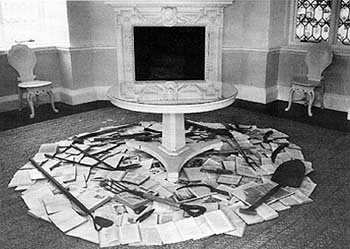

The Castle, Saltram House, Plympton, 1991
“... Built in 1760, the octagonal garden folly in the grounds of Saltram is known as ‘The Castle’. The building comprises of two styles; a Gothic exterior with a Classical interior. Its Gothic exterior invokes an emotive and physical response in contrast to the balance and reason instilled by its Classical interior. The installation focused upon these two conflicting elements to debate upon the issue of the division between the physical and mental labour and its inherent contradictions. Standing within the castle there would normally be an almost panoramic view of the garden and the surrounding landscape. This view has been obscured by a veil of ordered instruction on the rudiments of the labour of gardening which is often unsung, obscured and hidden in history. On the ground lie open books of knowledge and learning anchored by the manual tools which have contributed to the making of the garden. It is a scene of siege and also a testimony to the joint forces of hand and mind.”
„... A Saltram földjén, 1760-ban épült nyolcszögletű kert-rom ma „A Vár” néven ismert. Az épületre két uralkodó stílus jellemző: a gótikus külső klasszikus belső teret takar. A gótikus külső érzelmeinkre hat, ellentétben a racionális egyensúlyt árasztó klasszikus belsővel. E két ellentétes elemre fókuszálva az installáció a fizikai és a szellemi munka szétválasztásának kérdésével, és az ezzel kapcsolatos ellentmondásokkal foglalkozik. A Vár belsejéből tulajdonképpen szinte körképszerű kilátás nyílna a kertre és a környező vidékekre. Ezt a látványt elhomályosítja a kertészeti munka mesterségesen létrehozott alapelveinek fátyla, ami gyakran rejtve maradt a történelem folyamán. A földön a tanulás, a tudás nyitott könyvein a kert kialakításánál használt munkaeszközök hevernek. Összecsapás színtere ez, és egyben a kézi és szellemi munka egyesült erőinek bizonyítéka.”